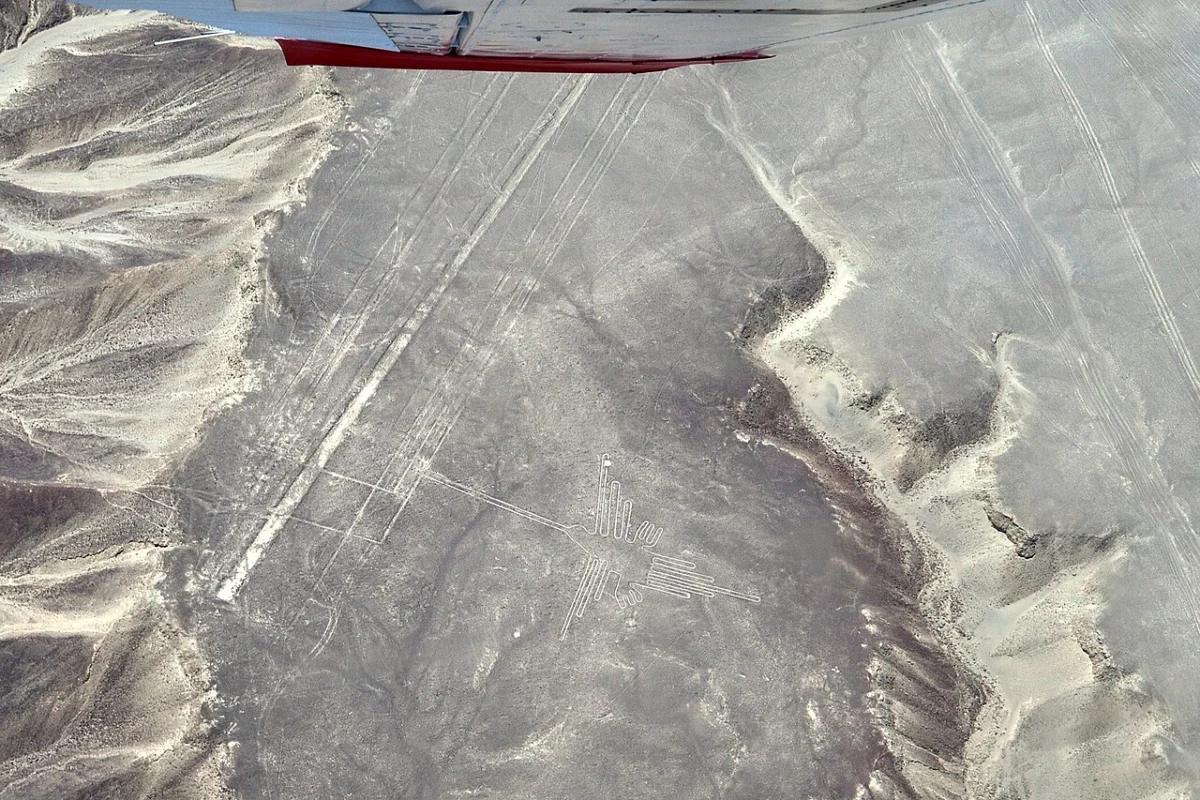
A bird stretches across the desert, yet no paint marks its wings. Its outline appears because people moved dark stones aside and let the pale ground beneath become the image.
The Nazca Lines purpose is harder to explain than their construction. Why turn a broad dry plain into a place of animals, paths, and vast patterns? Who was meant to see them, and what did that view mean?
A flight overhead offers a thrilling view. It can also encourage the wrong question. These images belonged to people who lived and moved through the land, not just to modern viewers who see them as pictures from the sky.
The desert drawings were made by people on the ground
Nazca geoglyphs were made by moving dark stones to reveal pale ground below. People used the desert itself as the surface for their art. The work did not need flight or alien help, though large designs did need planning, shared effort, and skill in working on the land.
UNESCO lists the lines and geoglyphs of Nasca and Palpa as a World Heritage property. It describes a long tradition of ground images, including living creatures, plants, and shaped forms.
The word geoglyph simply means a design made on the earth. Some designs outline figures; others stretch across the plain as lines and shapes that do not resemble a living thing.
Scale does not make human skill disappear
A modern viewer may wonder how someone could create an image too large to grasp at one glance. That is a sensible question. But it does not show that the task was impossible.
Ancient desert art also asks us to rethink what a picture can be. It need not hang on a wall or fit within the viewer's field of vision.
The makers had a culture beyond the famous lines
The Nasca made pots, cloth, and other works as well as the ground images. They built their lives in a dry coastal place and used a rich range of pictures. Those smaller works help us view the lines as part of a culture, rather than puzzles with no past.
The British Museum places the Nasca on Peru's southern desert coast and the western slopes of the Andes. Their culture developed from earlier Paracas traditions rather than arriving without a past.
Nasca culture is visible in objects small enough to hold as well as designs large enough to cross a plain. That range matters when we ask what an animal image meant.
The Metropolitan Museum of Art holds a bottle painted with hummingbirds. Its account connects richly painted vessels with offerings, feasts, processions, and other social and ritual uses.
Images can link daily life and ritual
A bird on a pot and a bird on the ground need not mean exactly the same thing. Still, both remind us that animals formed part of a broader visual world.
Objects, homes, paths, and ritual spaces help explain what the images meant in their own time. No single striking photo can reveal that whole setting.
This shift also restores credit to the makers. Their achievements belong to groups with craft skills and beliefs, not to an empty desert waiting for a fantastic outside account.
Were the lines part of a ritual landscape?
Clues from digs link many images with paths, rites, and shared beliefs. Where a design sits can matter as much as its shape. A ritual landscape may hold many kinds of acts, so a sacred role does not mean that every line served the same purpose in the same way.
The British Museum describes research suggesting that people moved along the lines in groups during rituals. UNESCO likewise presents the wider property as a sacred landscape shaped by people.
Movement changes how an image is experienced
Imagine seeing a design bit by bit as you walk. You first see an edge, then a curve, then a connection to a path or open space.
That experience differs from seeing a complete outline in an aerial photo. The figure can become part of a journey rather than a picture seen in a glance.
The ritual landscape idea therefore directs attention to links. Which designs lie beside trails, which connect to larger webs of paths, and where could people gather or pass through?
It also allows more than one group of viewers. A small group might see one image, while a wider group might use another place for a ritual.
These are useful questions because they make things to check on the ground. They are stronger than a claim based only on how strange a shape looks from an airplane.
The purpose of a sacred place can also change over time. A long tradition does not need every generation to repeat the same act for exactly the same reason.
New discoveries are changing the questions
A 2024 study found 303 new figures through image scans and work on the ground. The new finds showed gaps between small figures near trails and large line-type figures linked to broad networks. The team proposed different roles for these groups, though the meaning still depends on the full setting.
Yamagata University and its research partners studied photos to find likely places to check. People then checked the landscape, so a computer's hint did not become a proved discovery on its own.
The research team found that many small figures dealt with human life and could be seen from nearby trails. Larger line-type figures often showed wild animals and were linked to wider paths used for rites.
Finding more changes what we think is typical
If you know only a few giant images, it is easy to assume that all geoglyphs were designed for the same experience. A large sample of smaller ones can challenge that guess.
The earlier report of 168 discoveries in 2022 already showed the value of aerial images, drones, and field surveys. The later work pushed that search process further.
The Nazca Lines purpose may therefore become clearer through many small tests rather than one grand report that the whole mystery has been solved.
Why protecting the ground protects the answer
The ground images sit in a fragile place, and the land around them holds clues to their past. Damage can erase both an image and the signs of how it was used. Protecting Peruvian heritage keeps famous designs safe and leaves future teams a chance to ask better questions.
UNESCO credits the region's extreme dryness with helping the designs endure. It also names damage linked to the highway that crosses part of the property.
An image scratched into the surface is at risk in a different way from a carved stone statue. One small change to the ground can alter a line. Repeated damage can change the space around it as well.
The space between images is evidence too
A visitor may focus on the best-known animal outline. A researcher may also need the path beside it, the nearby surface, and the relation to a less striking shape.
Respecting access rules is therefore part of respecting knowledge. A closer view is not worth a lost clue, and a striking personal photo is not a match for careful records.
The most pleasing answer to the mystery may never be a single sentence. It may be a map of many practices, audiences, and meanings tied to different parts of the plain.
Look again at the bird in the desert. Its pale wings hold the record of people who knew how to shape a vast place with small acts of labor.
The wonder comes from that human achievement. To understand it, we must look beyond the sky view and study the ground where the makers lived, walked, and left their marks.
Used well, AI archaeology saves time in the search for faint marks. It does not replace the field team, which must still check each promising spot and record what lies there.
Frequently Asked Questions
These questions address who made the designs, why they made them, and what new tools can show us. Clues support human skill and several roles tied to social life or rites. They do not prove one single goal that fits every ground image made across this large desert place.
Were the Nazca Lines built for aliens or aircraft?
No sound clues from digs support that claim. Human construction is consistent with the visible technique and the broader social record, without needing viewers who could fly.
Do all Nazca geoglyphs have the same purpose?
The record does not show one purpose for every design. Recent research distinguishes smaller trail-side figures from larger line-type designs and suggests different social and ritual roles.
Did AI discover the meaning of the Nazca Lines?
No. AI helped researchers locate possible ground images in imagery, which field teams then checked. The meaning of the designs remains a reading drawn from digs based on their setting and spread.
Sources and further reading
This article draws on the records and research linked below. They let you check key facts, compare interpretations, and follow questions that remain open. The topic inspiration is credited separately from the sources used for the historical or scientific explanation.
- UNESCO: Lines and Geoglyphs of Nasca and Palpa
- Yamagata University: AI-accelerated Nazca survey
- Sakai and colleagues: AI-accelerated Nazca survey, PNAS 2024
- Yamagata University: 168 geoglyph discoveries
- British Museum: Who were the Nasca?
- Metropolitan Museum of Art: Bottle with hummingbirds
Topic inspiration: KhoaHoc.tv. Independently researched and written for Relic & Riddle.