The most famous library fire in history has no single date that historians can with confidence place on a calendar. The loss is real. But the familiar scene of each scroll going up in one terrible blaze is far less secure.
Library of Alexandria Myths thrive because a fire gives the story a clear beginning, a villain, and an ending. The surviving clues offer something harder: conflicting reports, different buildings, and large gaps.
Alexandria was a major city in ancient Egypt, and its learned world became famous for its bold aims. Yet fame is not the same thing as a full record of how its sets of books were built, used, or lost.
This is not a claim that nothing happened. Fires and violence struck the city, and books could be destroyed. It is a question about how much each clue allows us to say.
To follow the mystery, we need to separate a center of learning from its buildings, a shelf of scrolls from all human knowledge, and an ancient report from a modern retelling.
A Library Was More Than a Room Full of Scrolls
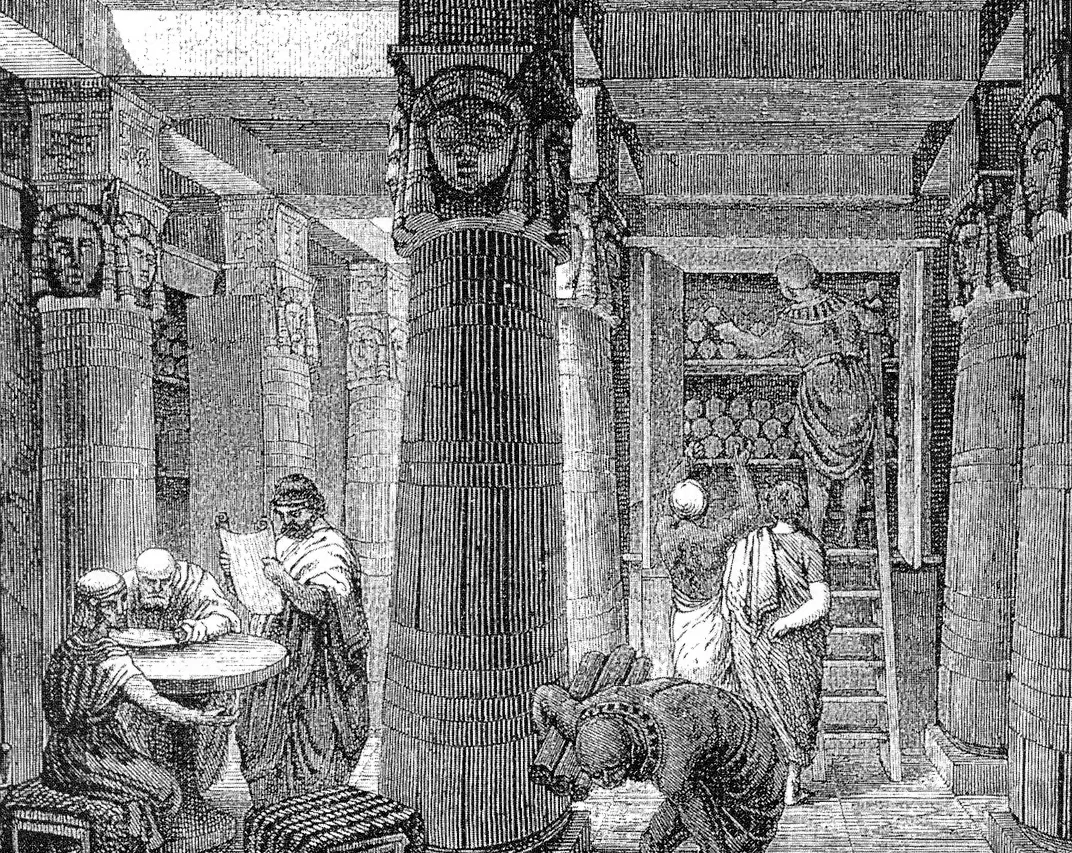
Alexandria’s library is linked with the Mouseion, a center of learning in the royal setting. Ancient reports describe a group of scholars. The clues about the books are much thinner than later stories suggest, so exact dates and sweeping claims about the library need care.
Strabo described the Mouseion as part of the royal palaces. His account includes places to walk and sit, a shared dining hall for learned men, and leadership supported first by kings and later by Roman power.
That glimpse matters because ancient scholarship required more than objects on shelves. It relied on people with time to study, a setting in which they could work, and support that kept the center of learning alive.
Royal support could make study prestigious. But it also tied learning to rulers and their changing aims. A set of books does not live outside the social world that maintains it.
The key difference is simple: we can recognize a key center of learning without pretending to know each room, rule, or shelf count. Respect for the library does not require filling each gap with grandeur.
The Numbers Sound Certain Until You Ask What They Count
Huge counts of Alexandrian scrolls are famous but hard to check, and one roll is not always one whole work. No full list of the books remains for us to study. Scholars thus question both the totals and the claim that the library held all knowledge.
A large number gives a lost library scale. It also gives a writer an easy way to measure tragedy: more scrolls appear to mean more knowledge vanished. But a count needs a clear unit before it means much.
A long work might occupy more than one roll. A set of books might also contain copies, versions, or texts arranged in ways that do not match a modern book count.
We should therefore avoid silently turning a reported roll total into the same number of unique books. That step adds facts the clues may not contain.
The Open University discusses Roger Bagnall’s challenge to the popular image of a set of books embracing all knowledge. The lesson is not to choose a smaller striking number and treat that as settled instead.
Alexandrian scrolls also belonged to a wider world of copying and spread. Even a great library was not always the only place where a text existed, which changes how we think about the effects of its loss.
What Caesar’s Fire Can and Cannot Prove
Caesar’s fire in the Alexandrian war of 48 BCE may have caused serious book losses. Plutarch later said it spread from the docks and burned the great library. Other reports differ, and we cannot be sure which books burned or how much of the library was lost.
The setting is vivid without added invention: a fleet, a besieged commander, and fire used in a struggle for control. A fire near a busy harbor could threaten materials beyond the ships themselves.
Plutarch’s Life of Caesar connects that fire with the great library. This is a key ancient report. But it was written long after the event rather than by a keeper of books counting the losses as they occurred.
Comparing accounts raises problems. As the Open University notes, language about a library and language about books need not point to the same thing. Books in storage near a harbor would not by themselves be all the library’s books.
Caesar’s fire may therefore have caused serious losses without ending each part of Alexandrian learning. That is a narrower conclusion than the popular version. But it better fits the limits of the record.
What remains unwise is building a full list of lost ancient books from one brief account. A report of burning cannot tell us each title, each copy elsewhere, or each idea that failed to survive.
The Serapeum Adds Another Place and Another Date
The Serapeum was a temple site linked with a separate library, often called a daughter collection. Its loss in 391 CE was a different event from Caesar’s fire. We do not know enough about its books at that time to prove a simple second-burning story.
The Serapeum library is key partly because it breaks the single-building picture. If accounts refer to different sets of books at different sites, one event cannot explain each use of the phrase library of Alexandria.
The loss of the temple complex occurred amid religious conflict in late antiquity. It is a serious event in history. But an account of a temple’s loss is not by itself a list of books destroyed with it.
A careful reader needs to ask what a source actually says. Does it describe books present at that moment, refer to a library from an earlier period, or combine episodes separated by centuries?
That same test applies to the later story blaming the Arab conquest. The clues are too weak to present that tale as a settled final act in which an intact great library was lost.
It would be easy to choose one group as the villain and let the story stop there. It is harder, and more useful, to notice when later writers turn an uncertain loss into a judgment about whole communities.
Library of Alexandria Myths can carry modern meaning in politics as well as ancient detail. Checking a date and a source helps prevent a compelling account from becoming a vehicle for inherited blame.
Knowledge Can Disappear Without One Final Blaze
Lost ancient books could vanish through fire, neglect, damage, or a failure to make new copies. Slow decline is a view held by scholars, not a full record of the end. Some works lived on elsewhere, so both loss and survival took place across many sites.
A written text survives only when something keeps it readable and useful. Storage matters.
But so do people willing and able to replace worn copies. A center of learning can lose that power without a single night that explains everything.
This gives gradual decline a simple logic. Changing support, repeated conflict, or interrupted copying could weaken a set of books over many years. The logic is strong, although the missing records prevent us from writing a full final chapter.
The Bibliotheca Alexandrina explains that no actual scrolls from the ancient library are known to survive as such. Some works linked with the ancient learned world did pass onward through copies and translations, including Euclid’s Elements.
That difference matters. The survival of a work is not the survival of the actual roll once held in a famous room. Nor does the loss of that roll prove that each version of the work vanished.
The modern Bibliotheca Alexandrina, opened in 2002, carries the memory of the ancient center of learning. It offers a living answer to the idea that knowledge needs people and public support, though it cannot recreate an exact ancient set of books.
There is no honest way to calculate how many centuries of progress one fire supposedly cost the world. Such claims require a chain of guesses about missing texts, later choices, and inventions that might have followed.
The real story needs no invented time machine. A great center of learning was lost, the clues about it became patchy, and later readers kept asking what had happened. The best tribute is to keep those questions clear while protecting the knowledge we can still pass on.
Frequently Asked Questions
These questions cover the details readers most often want to check before sharing this story. The answers separate what the evidence supports from what remains in doubt. They also explain why a clear account needs limits, even when a striking version would be much easier to remember.
Did Julius Caesar destroy the entire library?
His fire is linked to book losses in ancient accounts. But the extent is in doubt. It is not safe to claim that each set of books and all learned activity ended in that single event.
How many scrolls did the library hold?
No surviving list gives a safe total. Ancient numbers are debated, and rolls cannot be converted directly into a count of unique modern books.
Did all Alexandrian knowledge disappear?
No. Some works continued through copies and translations outside the original set of books. The library’s disappearance was a major loss, but it was not the erasure of each idea associated with Alexandria.
Sources and further reading
This article draws on the records and research linked below. They let you check key facts, compare interpretations, and follow questions that remain open. The topic inspiration is credited separately from the sources used for the historical or scientific explanation.
- Open University: Library of Alexandria
- Roger S. Bagnall: Alexandria, Library of Dreams
- Plutarch: Life of Caesar, chapter 49
- Strabo: Geography, Book XVII
- Egypt Ministry of Tourism and Antiquities: Alexandria
- Bibliotheca Alexandrina: Frequently asked questions
- Antiquities of Bibliotheca Alexandrina Site
Topic inspiration: KhoaHoc.tv. Independently researched and written for Relic & Riddle.