
Your watch could keep ticking while a friend far away sees your signal fade toward darkness. Falling into a black hole forces two viewers to tell very distinct stories about the same trip.
Neither view offers a safe escape once the last boundary has been crossed. But the path to that boundary can be far stranger than a simple plunge into a black pit.
This is a thought experiment based on physics, not a mission humans can make. To keep the story clear, picture a quiet, nonrotating black hole, then add the real-world hazards one at a time.
The boundary is not a solid wall
An event horizon is the boundary beyond which an outward signal cannot reach the distant universe. It is not a hard surface that you strike. In an ideal, very large black hole, crossing it need not cause an immediate local jolt, though returning outside becomes not possible.
Picture a warning line that no flashlight can report crossing from the inside. That is closer to the idea than a dark doorway made of stone.
The blackness comes from the fate of light. Outside the event horizon, some paths lead away; inside it, no future path for a light signal leads back to the far-off observer.
A rocket does not solve this by using a larger engine. The problem is not a shortage of fuel in a race against normal wind.
You have entered a region where the structure of space and time rules out the needed route. That is why the boundary matters even if your instruments record no impact.
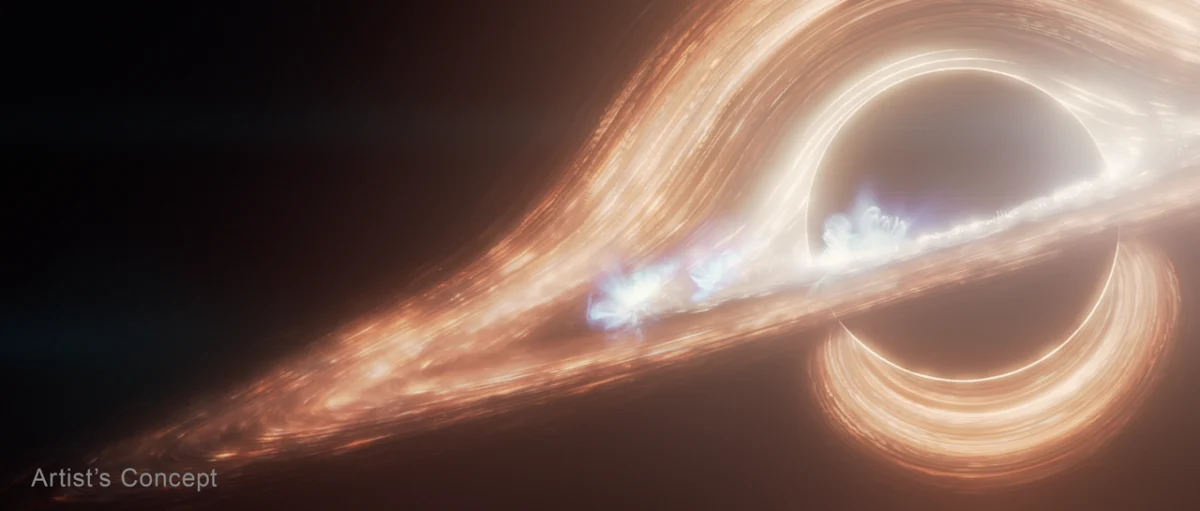
It also helps to separate a black hole from the bright matter near it. The glowing ring in a picture is not the black hole shining from within.
Light from nearby gas can reach telescopes before that gas falls past the boundary. Scientists use that light, and other effects on nearby objects, to study what they cannot see directly.
A black hole is thus neither an empty hole nor a cosmic drain that sucks everything from any distance. It is an object whose mass is packed into an extreme region.
The boundary makes it special. Grasping that boundary is the first step toward grasping your imagined trip.
The sky bends before the plunge
Light near a black hole follows curved paths, so the nearby sky can look warped and repeated. A bright accretion disk adds another visual layer. These effects arise outside the horizon and help explain why realistic black hole images look stranger than a flat circle in space.
Think of a star whose light starts well behind the black hole. Some of that light can bend around the mass and arrive at a camera on the other side.
The result is not a view through the black hole. It is a detour taken by light outside it.
If an accretion disk surrounds the object, the far side can seem to appear above and below it. The image is a puzzle about paths, not proof that the disk has folded into those shapes.
NASA has built visual models that follow a camera toward a supermassive black hole. These models let us inspect views no human observer can safely bring home.
A glowing disk is also a warning. Hot gas and radiation can make the region deadly well before the camera in a model reaches the last boundary.
For our imagined traveler, a quiet black hole removes that extra danger from the first picture. It lets us focus on gravity, then remember that nature need not provide such a clean setting.
Why the size changes the danger
Tidal forces arise because gravity pulls more strongly on the nearer part of your body than the farther part. Near a small black hole, this difference can become fatal before you cross the horizon. Near a huge one, the horizon may be crossed before severe stretching begins.
Suppose your feet point inward. They fall in a region where gravity is stronger than at your head.
Your body now has a problem with unequal pulls. The danger comes from that difference, not just from the overall strength of gravity.
Spaghettification is the vivid name for stretching along one direction while being squeezed along others. It describes a real effect, even though the kitchen image makes it sound playful.
A larger black hole has a larger horizon. At that boundary, the change in pull across a human-sized body can be much smaller than at the horizon of a small one.
This does not make the large black hole a safe destination. It changes when the journey becomes fatal.
The phrase falling into a black hole hides many kinds of settings. A small one, a large one, and one wrapped in blazing gas do not offer the same approach.
A useful explanation states the settings first. Only then can it tell you where the worst tidal forces would arrive.
Two clocks tell one consistent story
Time dilation means that distant and nearby observers can assign distinct elapsed times to events near a black hole. A distant viewer receives increasingly delayed, reddened, and faint signals from an infalling traveler. The traveler can cross the horizon in finite own time, without seeing their own watch stop.
Put a watch on the traveler and a second one far from the black hole. Each watch marks time along its own path.
As signals climb away from the strong gravity, the far-off friend receives a changing view. The traveler appears to slow, while the light grows redder and dimmer.
This does not leave a clear, frozen astronaut on display forever. Real signals become too faint to detect.
From the traveler's side, their pulse and watch continue in the normal local way. Time dilation is not a feeling that their thoughts have turned to syrup.
The two accounts do not require two opposite fates. They describe one path using distinct clocks and distinct access to details.
A movie may show the outside universe racing ahead in a simple montage. Real views depend on the route, the black hole, and which light reaches the observer.
We should not promise a complete preview of the universe's future. A dramatic image is not the same as a result worked out for a given journey.
The point that survives every clear version of this story is the loss of contact. After crossing, the traveler cannot send a fresh report to the distant friend.
The silence has a clear cause. The needed outward path no longer exists.
The last mystery is where theory reaches its edge
A black hole singularity is a prediction of classical general relativity where the usual description breaks down. Scientists do not have a tested account of all physics in that region. This gap does not show a portal, a second universe, or any route for a traveler to escape.
Here the story must slow down, even if the imagined traveler cannot. We have reached the boundary of what a familiar theory can describe.
The black hole singularity is often pictured as a small object sitting at the center. That picture can hide the more serious issue: the equations predict extreme behavior they cannot fully explain.
A more complete theory may need quantum effects. Scientists do not yet have a verified account that turns the deepest interior into a mapped landscape.
We can enjoy those tunnels in fiction while keeping the claims apart. A film can explore a possibility for emotional effect; a scientific statement needs evidence and a test.
There is also a firm distinction between not knowing every detail inside and knowing nothing about black holes. Their effects outside can be tested, modeled, and compared with findings.
The horizon sets a limit on reports from within. It does not erase everything scientists have learned from the region around it.
Your final imagined view thus ends with two truths. Physics can explain much of the approach, and a part of the interior remains unsettled.
The wonder comes from holding both at once, without turning either into a promise of survival.
Frequently Asked Questions
These answers address common questions about this topic, with a focus on what the evidence supports and where it stops. They separate tested results from popular claims, so you can leave with a clear picture rather than a longer list of myths.
Would I die at once at the event horizon?
Not necessarily in an ideal, very large black hole, where tidal forces at the horizon can be modest. The nearby environment and the later inward journey can still be fatal; crossing does not create a safe path out.
Would someone see me frozen at the edge forever?
A distant viewer would receive delayed signals that become redder and dimmer. In practice, the traveler fades from detection rather than remaining a bright, sharply visible figure forever.
Can a black hole take me to another universe?
No tested evidence shows that a black hole offers a usable route to another universe. Such journeys belong to speculative models and fiction, not an known travel option.