
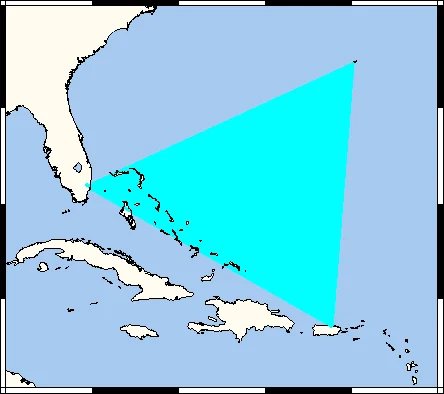
Five Navy aircraft went out on a training flight in 1945, and none came home. A search aircraft was then lost as well. The tragedy was real, but the legend built around it would grow far beyond the known facts.
If you want the Bermuda Triangle explained, begin with that difference. An event can remain unsolved without pointing to a force that breaks the rules of nature.
The Atlantic holds dangers that need no portal or curse. Weather changes, fuel runs low, crews lose their way, and the sea can swallow the clues. The challenge is to respect the missing people while refusing to turn doubt into proof of something strange.
Is the triangle a real place or a story on a map?
The Bermuda Triangle is a common name for part of the western North Atlantic, not a zone with fixed official borders. Accounts draw its edges in different places. NOAA says there is no evidence that strange losses happen more often there than in other large, busy parts of the sea.
But a popular outline is not the same as a measured hazard boundary. If writers choose different borders, they can also choose different sets of incidents to include.
The missing traffic count
Suppose one harbor reports ten accidents and another reports five. The first sounds more dangerous until you learn that it handles many times more traffic.
The number of losses must be weighed against the amount of travel. This example shows the logic; it is not a count of the triangle's accident rate.
Bermuda Triangle disappearances often reach readers as a list of striking stories. A list can be memorable while leaving out the many voyages that ended without incident.
The first question concerns both numbers and past events. What evidence would show an odd risk, and does the claim actually supply it?
Flight 19 was a tragedy before it became a symbol
Flight 19 vanished during a Navy training flight over the Bahamas on December 5, 1945. Radio reports showed trouble with the route and compasses, but no confirmed wreck was found. The loss helped build the legend, though the known clues point to a flight in distress rather than strange forces.
Naval History and Heritage Command names five TBM Avenger aircraft and fourteen men in the missing formation. A PBM Mariner sent to search was also lost with thirteen men aboard.
The Navy account describes a likely in-flight fire for the search aircraft. That is a distinct proposed cause, not proof that both losses shared a strange force.
The Flight 19 mystery is hard to tell responsibly because the final moments cannot be fully rebuilt. Yet the surviving radio records give more than a blank page.
Separate what is known from what is guessed
We can distinguish the takeoff, the radio reports, the failed return, and the search that failed. We cannot turn those facts into a firsthand account of every cockpit choice.
A vivid retelling may fill gaps with thoughts, dialogue, or panic. Unless those details come from records, they belong to storytelling rather than documented history.
The absence of proved wreckage also has limits. It tells us that the search did not resolve the loss; it does not prove that a strange force caused the loss.
The sea can remove both a vessel and its clues
Storms, shallow water, and strong currents pose known risks in this part of the Atlantic. They can also hinder a search after a loss. A missing wreck does not prove a strange force was at work, since the same sea that caused trouble can hide the clues.
NOAA points to tropical weather, hazards along a route, and changing sea conditions as useful factors to weigh. These hazards happen beyond the triangle too.
Atlantic storms can threaten a vessel while making it harder for rescuers to reach a reported place. Bad weather affects the emergency and the response at the same time.
The Gulf Stream current adds movement to the picture. NOAA describes it as a warm current running north along Florida before turning toward the wider Atlantic.
Its average speed is about four miles per hour, though speed varies. That fact does not reveal the path of any specific missing vessel. But it shows why a search position is not fixed forever.
A last-known place is only a starting point
When search teams receive a position, they still need to know how long ago it was recorded. Time can widen the gap between where an object was and where it might now be.
A boat, debris, and a person in the water may also react in different ways to wind and waves. A simple arrow on a map cannot capture all those differences.
Why a compass does not need a curse to confuse you
A compass points toward magnetic north, not always toward the North Pole. Sailors account for that gap through magnetic declination. A wrong reading can lead to errors, but it does not prove a special triangle effect; each claim must be checked against the tools and conditions at the time.
NOAA's chart guide explains that compass roses can show both true and magnetic directions. The difference depends on place and changes over time.
Ocean navigation therefore needs more than following a needle. It involves using the right chart facts and knowing which kind of north a direction describes.
Small errors can become large distances
Picture two paths that leave the same point at slightly different angles. The farther they extend, the greater the gap between their endpoints.
Those two paths show why a modest direction error can matter during a long voyage. It does not show the exact cause of any named accident.
A compass problem also needs careful wording. An instrument may be faulty, a reading may be misunderstood, or a navigator may be unclear about the present position.
Those are different issues and need different evidence. Treating every report of doubt as a needle spinning wildly adds a detail the record may not support.
Modern devices can offer more facts, but the past cases often involved older tools and limited radio contact. We should judge those crews within the conditions in which they worked.
Why the legend survives an account based on science
The legend links separate losses with one neat shape on a map. Natural causes do not explain every detail of every old wreck or lost flight. Yet a gap in the record is not proof of a shared strange cause, and each case needs its own study.
Naval leaders and the Coast Guard reject the idea of a strange local hazard. Their position does not promise that every old incident can now be solved.
The loss of the USS Cyclops in 1918, for example, remains an unsolved case at sea. The Navy lists it in its list of books and articles about the triangle while noting the gaps in the record.
A collection of unsolved events can feel like one giant puzzle. Yet the ships, aircraft, weather, dates, and evidence may differ sharply from one event to the next.
One rule makes the mystery clearer
Ask what connects the cases beyond a broad place. Is there a repeated physical clue, a shared cause, or only the fact that the endings are unknown?
Then ask what evidence could disprove the proposed cause. A claim that explains every possible result may be impossible to test, which weakens its value as an account.
There is room for wonder without pretending that the ocean holds a proven portal. The real sea is vast, powerful, and difficult to study.
Read a missing-vessel story with two kinds of patience. Be patient with the limits of the records, and be patient with the people who search rather than rush to a striking answer.
The legend will likely remain popular because a triangle is easy to remember. The truth asks more work: separate cases, check sources, and allow some questions to remain open.
That effort brings the missing people back into focus. Their losses deserve understanding, not a single convenient myth stretched across the Atlantic.
Frequently Asked Questions
These questions address the gap between the legend and the facts of each loss. The triangle is famous, but it has no fixed official border. The sea has known risks, while the final moments of some old voyages remain unclear and must be judged from their own records.
Are ships unusually likely to vanish in the Bermuda Triangle?
NOAA says there is no sign that strange losses are more common than in other large, well-traveled ocean areas. Raw lists of losses do not show a risk without matched traffic data.
Was Flight 19 lost because of a strange force?
No sound evidence proves that claim. Navy records describe problems with the route and compasses before contact was lost, while the exact final sequence remains unsolved.
Does the Bermuda Triangle have official borders?
No official map defines a special triangle danger zone. Different popular accounts draw different borders, which makes claims about incident counts harder to compare.