Two stone figures stand taller than a one-story house, but their makers left no written names. Their arms are carved along the sides, their hands rest near the waist, and their heads take the shape of a broad letter T.
They belong to Göbekli Tepe in southeastern Türkiye, a place built more than eleven thousand years ago. The Gobekli Tepe builders lived near a major shift in human life, as groups moved toward farming.
Yet their huge stone works show that people could plan ambitious projects before cities, kings, or metal tools entered the picture.
Who Lived in This Early World?
The builders lived in Upper Mesopotamia during the early Neolithic age, in the tenth and ninth millennia BCE. Evidence ties them to hunting, gathering, and the shift toward more settled lives. They were skilled people who knew their local world and could plan great works.
A well-known story says that farming came first, then villages, then large monuments. Göbekli Tepe makes that sequence less tidy. People who depended strongly on wild food could also organize major building work.
This does not mean they wandered without roots or plans. Hunter-gatherer societies vary widely.
Groups can return to known places and share food. They can make friends and plan work across seasons.
None of this requires a city.
UNESCO places the structures within the Pre-Pottery Neolithic. This was a time before pottery became a normal part of local life. It does not mean the people lacked containers, art, or craft skill.
Calling them simple would miss the evidence in front of us. Each pillar required an idea, a suitable stone, skilled labor, and a place to stand.
Someone had to plan the tasks. Everyone still needed food and water.
We cannot recover a census or a list of names. Nor can we prove that every worker had the same role. The site allows us to ask about these early lives, but it does not turn each question into an answer.
How Did They Shape and Move the Pillars?
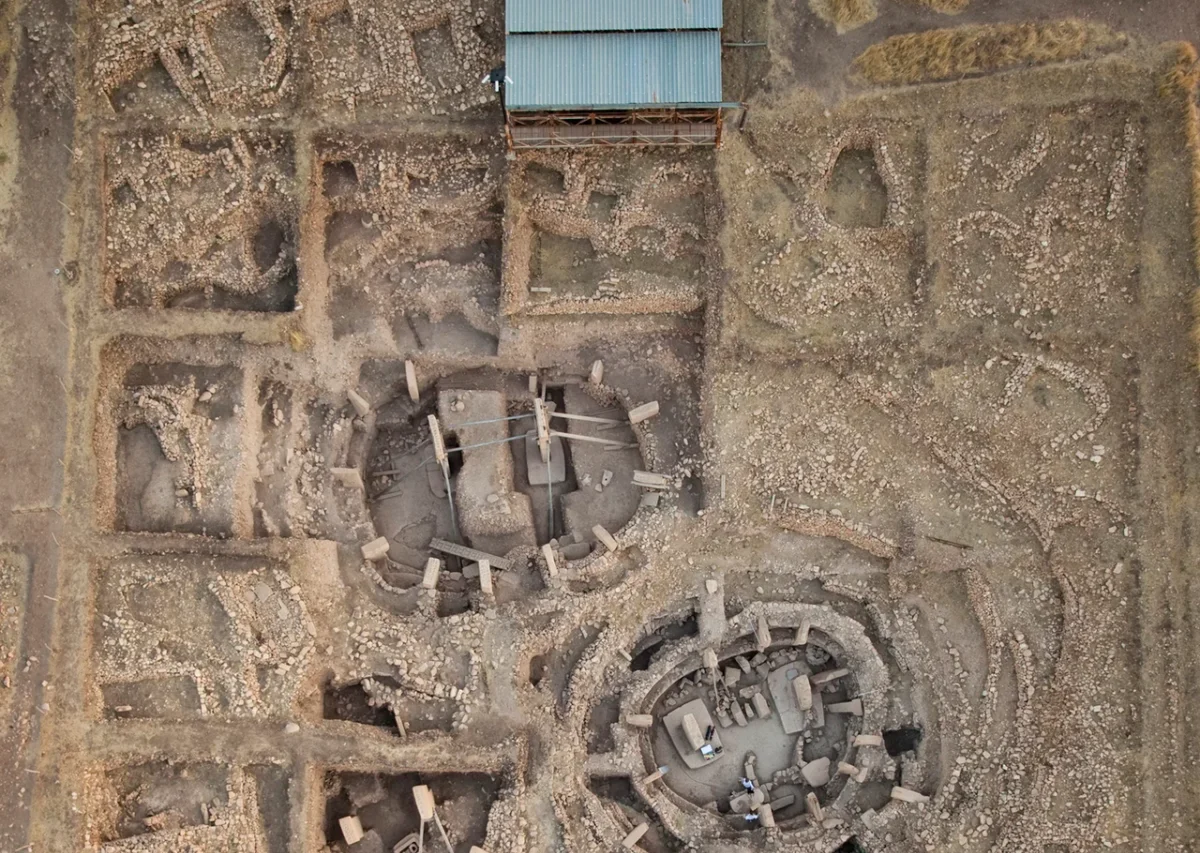
The limestone came from the plateau beside the site, where quarry traces help explain its source. Builders used stone tools to carve large blocks and raise them within planned structures. The exact transport methods remain unclear, but nearby stone and group labor help explain the task.
The largest central T-shaped pillars in Building D reach about eighteen feet in height. Excavators estimate weights of roughly eight to ten metric tons each. Those figures should inspire respect for the work, not a leap to supernatural help.
The plateau served as a limestone quarry. Tool marks and unfinished workpieces connect the raw stone with the finished monuments.
Local stone cut the distance a heavy block had to travel. Even a short trip would take care.
Stone tools can work softer stone through repeated blows, cutting, and abrasion. The key is sustained effort.
A small flake may look weak in a museum case. Much depends on how it is used.
Time and skill also count.
Ropes, sledges, wooden aids, and group hauling are possible ways to move the stones. Their use in a specific operation must still be tested against evidence. A method that could work is not proof of a method used.
Imagine the risk rather than an invented scene. A stone tipped too far could break.
A base set poorly could shift. A team would need to judge weight and balance.
They would check the ground before raising the stone.
The achievement thus includes decisions that left few traces. Archaeology finds stone more readily than planning.
The plans are now out of sight. Yet they helped make the stones stand.
What Do the Animals and Stone People Mean?
Carved animals, human details, and abstract signs form a rich visual world across the monuments. Some central pillars take human form, while animal patterns differ among buildings. These images likely carried shared meanings, but no saved text supplies a complete key to their stories or rituals.
Foxes, snakes, boars, and birds appear in the carved imagery. These creatures lived in the builders’ world.
An animal in art can also stand for something else. It might also mark a group, a tale, or a valued quality.
Some pillars include arms, hands, belts, and clothing details. Those clues make their human form hard to miss. Still, calling every figure a god would go beyond what the stone alone can tell us.
DAI scholars note patterns across buildings. One favors foxes; another shows more boars.
These contrasts raise questions about group identity and use. They do not provide a ready-made list of tribes.
We meet a similar problem when viewing a strange flag. We may spot its bird or star while missing the history that makes the image matter. Göbekli Tepe offers the symbols, but much of the shared background has disappeared.
Some human skull fragments carry deliberate grooves and a drilled hole. A 2017 study linked these changes to treatment of the dead.
Display was one proposed use. The finds give clues about ritual.
They do not reveal a whole belief system.
Feeding a Crowd Was Part of the Project
Food remains and thousands of grinding tools show that eating was central to activity at the site. Studies link much of the equipment to cereal processing and hint at large shared meals. Ritual feasting is a useful model for organizing labor, though scholars continue to examine how gatherings worked.
A monument needs workers; workers need meals. That plain fact leads away from the tallest stones toward smaller pieces worn smooth by use. Grinding slabs and handstones reveal effort spent on food rather than display.
A 2019 study examined more than seven thousand grinding tools. Scholars checked wear against marks made in tests.
This helped tell grain work from other uses. The result gives plant foods a stronger role in the story.
The presence of wild cereals does not mean the builders already practiced fully developed farming. Picking wild plants, growing crops, and breeding them are linked but distinct steps. Changes in how people used plants unfolded across long spans of time.
Animal bones also point to hunting, including gazelle. Large amounts of meal waste hint at shared work feasts.
A feast could reward work. It could also unite people from different homes.
Picture the logistics as a question, not a reenactment. How many people could a group feed?
Who ground the grain? How long could a gathering last?
The answers affect what sort of work a group could attempt.
Neolithic monuments were built with stone, but food helped make them possible. A worn grinding surface can thus be as revealing as a carved animal. One shows what a group chose to display; the other shows labor that kept people going.
Why the Story Keeps Changing
New research has made simple labels less secure. Domestic structures have now been found, and the filling of buildings involved multiple human and natural processes. Göbekli Tepe remains striking, but describing it only as an isolated temple deliberately buried in one act misses the growing evidence.
Older accounts often described a place with no houses, used only for ritual gatherings. Current UNESCO guidance notes remains that appear to be domestic buildings. The site’s daily life may have been more varied than the early model allowed.
The same caution applies to burial. Scholars once emphasized purposeful backfilling of the special buildings.
The dig team now describes a more complex process. Human dumping took place alongside slope movement and other natural events.
This is not a reason to distrust archaeology. It shows the discipline working.
Early ideas guide excavation; new deposits test them. A good account follows new evidence.
A catchy headline must not fix the story in place.
The phrase world’s oldest temple can be a handy introduction, but temple is a modern label. It hints at religion and one main use. The builders may have linked home, gathering, memory, and ritual in other ways.
Nor does the site prove that one cause created farming everywhere. Human groups followed varied paths.
At Göbekli Tepe, work, food, settled life, and belief may have shaped each other. They need not fit one fixed order.
The Gobekli Tepe builders remain unnamed, yet they are no longer invisible. Their stone tools, meals, and monuments preserve a record of effort. The mystery is how their social world worked, not whether humans were capable of building it.
Frequently Asked Questions
These answers address the questions readers often bring to this topic. They separate what the surviving evidence shows from what scholars still debate, so you can follow the story without mistaking a useful theory, a modern model, or a well-known legend for a proven fact.
Did farmers build Göbekli Tepe?
Evidence links the builders to hunter-gatherer groups living during the transition toward farming. Plant use and cereal processing do not by themselves prove fully domesticated crops or mature agriculture.
Was Göbekli Tepe buried all at once?
The excavation project now describes several filling events involving both human actions and natural movement of sediment. A single planned burial of the whole site is too simple a description.
Were the T-shaped pillars human figures?
Arms, hands, belts, and clothing on some pillars support that reading. Their exact identities and the meanings of their animal carvings remain unclear.
Sources and further reading
This article draws on the records and research linked below. They let you check key facts, compare interpretations, and follow questions that remain open. The topic inspiration is credited separately from the sources used for the historical or scientific explanation.
- UNESCO: Göbekli Tepe
- Göbekli Tepe Research Project: FAQ
- Dietrich: Making and moving monoliths
- DAI: Cereals, feasts and monuments
- Dietrich et al.: Cereal processing
- Gresky et al.: Modified human crania
- DAI: Neolithic gathering and feasting
- Dietrich et al.: Bread and porridge
- DAI: A sanctuary or house?
Topic inspiration: KhoaHoc.tv. Independently researched and written for Relic & Riddle.