
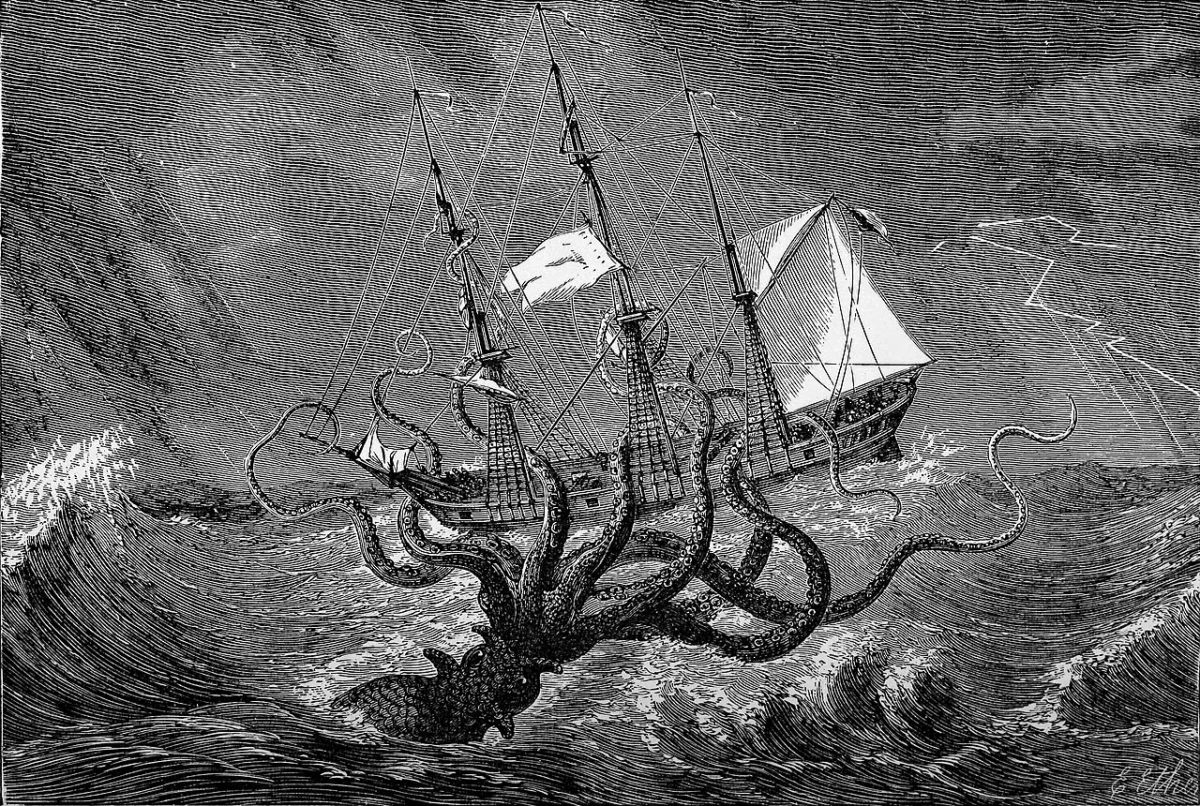
A creature longer than many boats can spend its life in water that people rarely see. When its torn body finally reaches shore, it can look like a message from a world without known rules.
Here is the Kraken legend explained. The ship-destroying monster belongs to folklore, while the giant squid belongs to science.
The real animal does not need a taste for sailors to be striking. Its huge eyes, long feeding tentacles, and hidden life show how a real squid can give imagination far more room than a clear photo ever could.
Where a Sea Animal Becomes a Monster
The kraken belongs to Scandinavian folklore, where it is often pictured as a huge, dangerous sea creature. Large squid are likely influences on that tradition, especially when people encountered damaged remains. That connection is an answer for some imagery, not proof of every claimed monster.
Scandinavian sea monsters grew in a world where the sea carried food, trade, risk, and things no one could name with confidence. A strange body on a beach offered both a clue and a puzzle.
Soft tissues do not keep a neat animal shape as they decay. Arms can be lost, a body can swell, and traits that would make sense in living water can look alarming on sand.
Natural History Museum experts discuss large cephalopods as likely starting points for kraken stories. They also note how people could interpret strange remains through ideas from faith about odd sea beings.
The gap that a story fills
That is a likely route from a meeting to a legend. A witness sees part of an animal; a group supplies the rest.
The route does not mean we can trace every detail to one species. Folklore can combine sightings, fear, old stories, and later artwork.
Imagine receiving a report without a scale, a clear image, or a preserved sample. You might know that the witness saw something strange without knowing what the thing was.
A careful reader keeps that gap. An unexplained sighting leaves a question open; it does not prove a huge animal able to pull a ship under.
The Real Giant Squid Is Impressive Enough
Giant squid are real animals with eight arms and two longer feeding tentacles. Their total length can be striking, but sizes depend on how the soft body and tentacles are preserved. Scientists therefore treat dramatic size claims carefully and distinguish measured specimens from estimates.
The animal known as Architeuthis dux belongs to a group that includes many smaller squid. Its basic body plan is familiar, even when its scale is not.
The arms hold prey near a hard beak. The longer tentacles help reach and seize food farther from the body.
Smithsonian describes measured giant squid reaching about 43 feet in total length. That figure includes the long tentacles, so it should not make you picture a solid body as long as a large bus.
Why length can mislead
A ribbon and a wooden beam can have the same length while creating very different impressions of size. Something similar happens when people compare squid with ships or whales.
Damaged or stretched tentacles make comparisons even harder. Teams often use mantle length, the length of the main body, as a more useful measure.
Among useful giant squid facts is the simple rule that a claimed maximum is not a typical animal. Nor is a size estimated from another body part the same as a complete body measured directly.
London’s Natural History Museum has preserved a nearly complete giant squid about 8.62 meters long. The preserved squid lets teams inspect body parts, collect samples, and revisit questions that a fleeting sighting cannot answer.
Huge Eyes in a World Without Daylight
Giant squid eyes collect light in the dim deep ocean, where a large predator can be difficult to spot. Research has explored whether their size helps reveal nearby sperm whales. Their value is not simply making tiny objects look bigger in an otherwise empty black space.
The phrase giant squid eyes sounds almost like an exaggeration until you see a preserved example. These organs can reach the size of a dinner plate.
Yet big eyes are not magic lamps. They do not create light, and the deepest water does not suddenly become bright because an animal can see well.
Their advantage involves collecting the available light and detecting useful signals. A large moving animal can disturb small glowing life in the water, producing a pattern that may reveal its approach.
Seeing danger before it arrives
A study discussed by Smithsonian explored the chance to spot a sperm whale from a distance. The idea makes the eye a shield as well as a tool for finding food.
It also changes the role assigned to the squid. In a monster story, the animal is the danger below the boat. In its own habitat, the squid has dangers of its own.
This is a good reason to put the shipwreck tale aside. Traits make more sense when we ask what problem they solve for the animal.
We should still be careful with a proposed function. A model can support a useful answer without showing every behavior in the wild, where direct study remains difficult.
The Hunters, the Beaks, and the Hooked Cousin
Sperm whales eat squid, and hard beaks recovered from their stomachs give scientists clues about those meals. Giant squid also have a distinct relative, the colossal squid. Its hooks add another startling detail to real marine life, without making the two species interchangeable.
Soft prey can leave hard clues. A squid’s beak survives a whale’s gut, which destroys much of the rest of its body.
That helps teams study sperm whale diet. Recovered beaks and other remains show that these whales feed on squid, including very large ones.
Marks made by suckers can also reveal contact between animals. They invite dramatic pictures of underwater battles. But a scar does not supply a complete scene with a known beginning and end.
A different squid with different tools
The colossal squid is not just another name for the giant squid. They are different animals, and the colossal species is associated with Antarctic waters.
Te Papa’s anatomical work shows why colossal squid hooks attract so much attention. Some hooks on the tentacle clubs can swivel, while hooks on the arms have a different structure.
Those traits help us understand a system for gripping prey. They are clues about an animal’s feeding gear, not clues of a hidden habit of hunting ships.
The gap matters when a viral image mixes names. If the caption calls a giant squid a colossal squid, check the name before repeating the sizes or body parts.
What Cameras Changed, and What They Did Not
Cameras have filmed giant squid alive, turning rare glimpses into clues teams can inspect. A 2019 NOAA-supported expedition filmed one near a lure in the Gulf of Mexico. Such footage confirms real behavior in a specific meeting, while leaving many wider questions about its life open.
The modern search for deep sea squid involves patience and careful gear. A camera must reach the right water, cope with the cold, and attract or meet an animal without ruining the study.
In 2019, teams using the Medusa camera system filmed a giant squid near an electronic lure. NOAA’s account describes an animal roughly 10 to 12 feet long moving close, then backing away.
The meeting is brief. That makes it useful in one way and narrow in another: we can examine what happens. But we cannot treat a short clip as the whole life of the species.
From a sighting to a testable record
Compare that footage with a sailor’s description. The recording can be replayed, slowed, and studied by people who were not present when the animal appeared.
That shared record is a major change in the quality of our records. It gives teams something to challenge and interpret together.
There is still room for wonder. We do not need every detail settled to appreciate an animal suited to a world we can enter only briefly.
There is also room for restraint. The footage does not show a kraken sinking a ship, and the existence of giant squid does not confirm every sea-monster report.
The best ending for this mystery is not that science makes the ocean dull. It is that careful study reveals a richer animal than the simple villain of a story, complete with prey, hunters, and a place in the living sea.
Frequently Asked Questions
These questions focus on the line between a powerful story and the clues behind it. The short answers explain what teams can support, what ancient writers actually describe, and which tempting claims still need proof before we can treat them as established facts.
Is the kraken a real animal?
The ship-destroying kraken is a creature of folklore, not a confirmed species. Giant squid are real and are likely influences on parts of the legend. But that does not establish the monster’s claimed size or behavior.
Are giant squid and colossal squid the same?
No, they are different species with different body parts and ranges. The colossal squid has striking hooks on its arms and tentacle clubs, so images and claims should be checked for the correct name.
Have scientists filmed a living giant squid?
Yes, teams have filmed giant squid alive, including in their natural deep-water habitat. A NOAA-supported team filmed a meeting in the Gulf of Mexico in 2019, providing clues that others can inspect.