
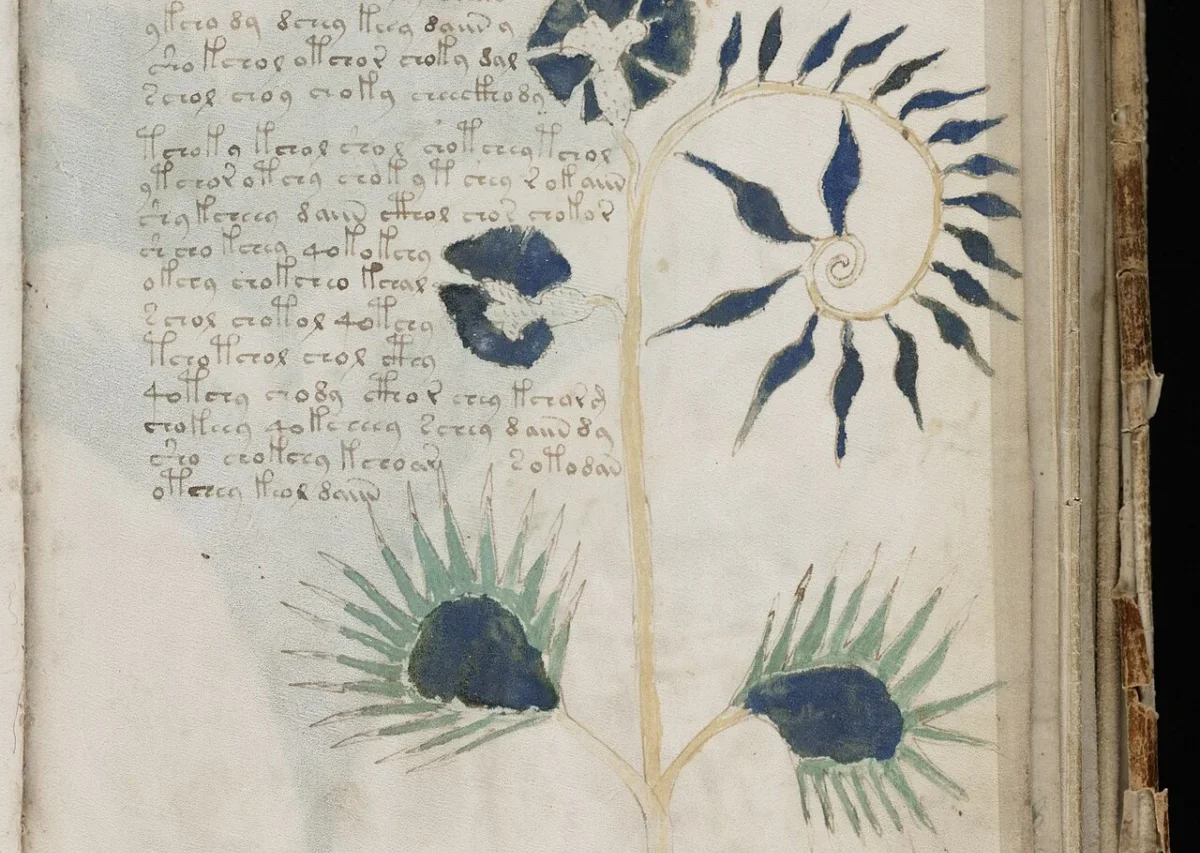
The plants look as if they should have names. Leaves spread across the page, roots twist below them, and neat lines of writing gather at their sides. Yet no agreed reading tells us what those lines say.
The Voynich manuscript mystery begins with that strange feeling of almost understanding. The book looks organized, with ink, color, pictures, and patterns. What they did not leave us was a key that everyone can use.
You can see the pages today through Yale's digital collection. The challenge is not finding the book. It is deciding what counts as reading it, and what only counts as seeing a pattern you hoped to find.
An unknown book with a very real body
The Voynich manuscript is a real book at Yale, not a tale known only from copies. Its ink, drawings, folded leaves, and lost pages can be studied while the text stays unread. These clues tell us about the book’s past, though they do not tell us what it says.
Yale Beinecke Library holds the book under the shelf mark MS 408. The name Voynich comes from the dealer Wilfrid Voynich, who bought it in 1912, rather than from its unknown author.
Arizona State Museum describes its parchment as carbon-dated to the early fifteenth century. A date for the support gives clues about the material, not a direct reading of the words written on it.
The Yale catalog also records folded leaves and gaps where leaves are missing. Those features matter because a modern sequence of pages need not preserve every step of the original design.
A book is more than its text
Think of a cookbook with its cover torn off and several sheets removed. Its stains, drawings, layout, and wear could still reveal things about its use, even if you could not read its language.
A lab report lists known ink and paint materials, such as iron gall ink and the blue pigment azurite. These findings offer a grounded route into a puzzle often wrapped in strange claims.
Why the pictures help and mislead
The pictures hint at plants, stars, baths, and cures, but we cannot read their labels. They help us ask useful questions about the text. Yet a wrong guess about a plant or scene can lead us to read false meaning into every mark that comes after it.
Yale groups the pictures into six broad sections. These include plant images, star and astrological diagrams, bathing scenes, circular designs, herbs and roots, and short entries marked by star-like shapes.
The botanical drawings are very tempting. A reader may spot a leaf that looks familiar, then assume the nearby word must be that plant's name.
That guess can become a trap. If the name is wrong, every letter value derived from the supposed name may also be wrong.
The pictures should narrow a question, not decide it
Artists also simplify, combine, and distort what they depict. A modern viewer may expect the precision of a field guide from a picture made for a very different purpose.
A careful researcher asks whether a name works across many pages. Does the proposed plant name recur where that plant appears again, and do the same reading rules still apply?
This is where a striking resemblance must become a repeatable test. A single strong picture is a clue worth exploring, not a reading worth claiming.
Does the strange writing behave like language?
Studies of word patterns find traits like those in real language, such as words that repeat in clusters. That weighs against simple random marks, but it does not name a language or read a sentence. A pattern can rule out some ideas while still leaving the text unread.
One 2013 PLOS ONE study tested word patterns of texts and found the manuscript a broad match for real languages. Its authors did not claim to decode it.
Another study that year examined how words appear together and across the book. It found organized patterns that the researchers interpreted as support for a genuine message.
The phrase Voynich manuscript language still names an open question. Language-like structure is not the same as naming Latin, a lost language, or any specific system of writing.
A pattern is not a meaning
These options demand different tests. A proposed reading should explain the full pattern of writing, not just a handful of marks that happen to resemble familiar letters.
Computers help find regular features across large amounts of text. They do not remove the need to check the guesses behind the data and the proposed reading.
Calling the book a medieval cipher is therefore a guess about how it works. An unknown script might encode a known language, record a new one, or serve another purpose that has not been firmly shown.
What a strong solution would have to do
A sound reading must work across the book with clear rules that stay the same. Other people must be able to test it and get the same result. A few guessed words or a story that seems to fit the pictures cannot prove that someone has cracked the text.
Claims of a breakthrough can be exciting. They can also hide a way that changes whenever the next line fails to cooperate.
Suppose a proposed sign means one letter on the first page, another on the second, and a whole word on the third. Such freedom may make many readings possible while making none of them open to tests.
A useful checklist for new claims
Ask whether the method gives a reading for pages not used to build it. That test helps reveal whether the solver found a general rule or merely fitted a few examples.
Ask whether the output makes sense without heavy editing. A sentence that becomes meaningful only after many chosen changes is weaker evidence than a direct, consistent result.
Ask whether another person can use the same method and obtain the same reading. A discovery should not depend on a private hunch.
Finally, look for views from other experts. A headline can report excitement, but excitement cannot replace a clear method.
How to explore the mystery without inventing an answer
Readers can view the scanned pages, compare pictures, and test claims while keeping what they see apart from what they guess. This makes the puzzle more useful and more fun. The aim is to learn why a real old book is hard to read, rather than invent its secret.
Start with a single page. Note what you can actually see: the number of lines, the position of labels, the shape of a repeated sign, and the relation between drawing and text.
Then write a second list for your guesses. Perhaps a mark looks like a heading, or a drawing suggests a certain plant. Keeping that list separate prevents an idea from quietly becoming a fact.
You can also compare pages with different kinds of images. Do similar signs appear near similar pictures, and does the pattern persist when you stop looking for it?
Access to scans opens this slow kind of study to anyone with an interest. It also lets readers check a striking claim against the page itself instead of relying only on someone else's cropped image.
What makes the book moving is the trace of effort. Someone prepared the leaves, wrote the lines, and arranged the pictures; those choices outlasted the shared knowledge that once may have made them clear.
The unknown script shows the limits of what we know now. It is not permission to fill the gap with any story that feels pleasing.
For now, the best visit with the book ends where it begins: with a page that seems close to speaking, and the patience to listen without supplying words of our own.
True manuscript decipherment would give readers a key they could test on a fresh page. It would open the text through a shared set of rules, not just a few lucky guesses.
Frequently Asked Questions
These questions keep the book apart from claims about its meaning. It is real, lab tests give clues to its past, and scans let us see it. Those facts do not supply a sound translation, so answers about its language must still leave room for what we do not know.
Has anyone translated the whole Voynich manuscript reliably?
No broadly accepted, repeatable translation is shown by the sources listed here. Studies of numbers can support structure in the text without showing what its words mean.
Does carbon dating reveal when the text was written?
It dates the parchment material, which lab testing places in the early fifteenth century. Dating the support is distinct from directly dating the act of writing.
Can I view the Voynich manuscript online?
Yes. Yale gives clear scans of the pages for research and study by anyone. Access to the fragile original is limited, so the scans are the useful starting point.