
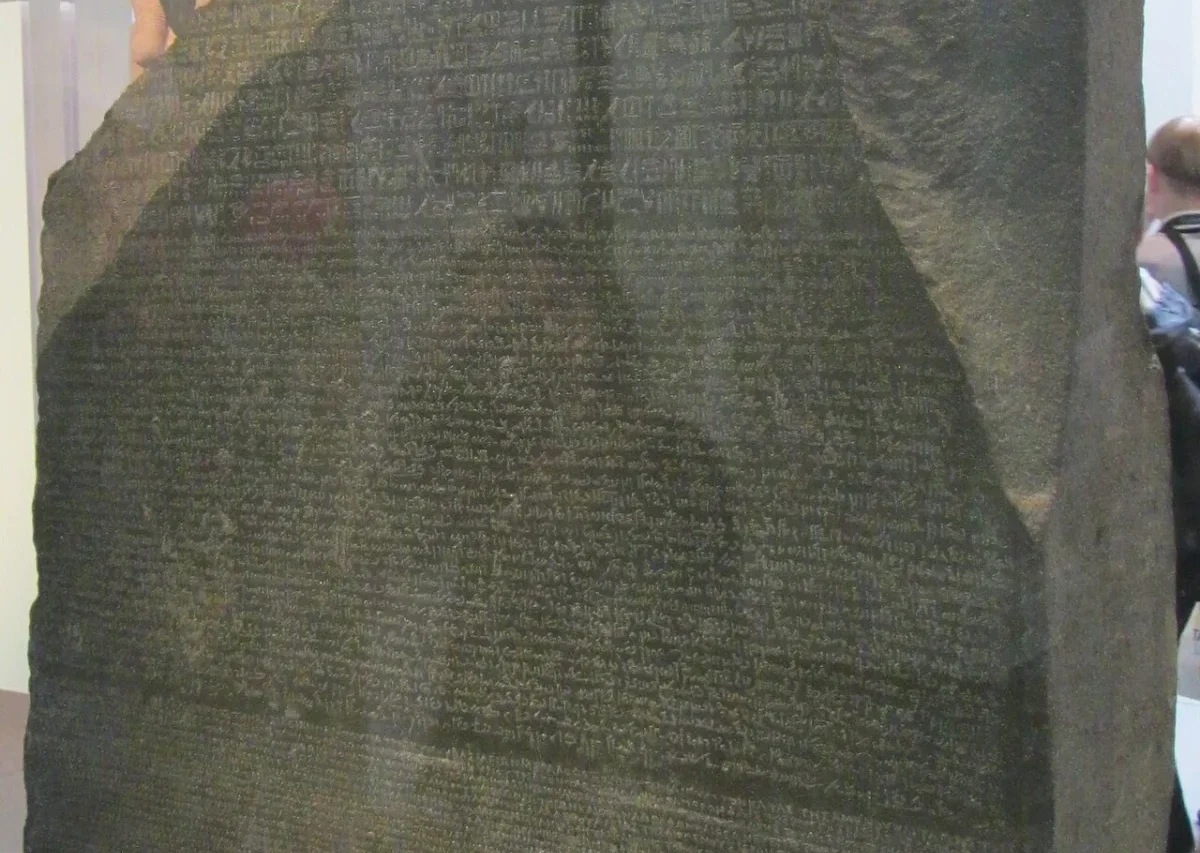
A royal tax decree became the key to a lost written world. The Rosetta Stone did not hide a treasure map or a secret spell.
It repeated one official message in three scripts. This gave scholars a rare chance.
They could check an unknown text against one they could read. Rosetta Stone decipherment took years because the real puzzle was larger than one slab.
Scholars had to learn how Egyptian writing joined sounds and ideas. They tested readings across names, monuments, and languages.
The Message Was About a King
The stone records a priestly decree from 196 BCE honoring Ptolemy V, with text in hieroglyphic, Demotic, and Greek writing. It concerns royal power and temple support during his rule. The repeated message helped scholars work out how Egyptian writing joined sounds and ideas.
The slab is part of a larger stone monument, called a stela. Its top is missing, so the hieroglyphic portion is broken.
Damage made the work harder. Enough text remained to connect the three sections.
Ptolemy V came from a dynasty with Macedonian roots. It rose in Egypt after Alexander the Great.
The decree affirmed his status and described benefits tied to his rule. It served the politics and faith of its time.
The Greek inscription mattered to modern scholars because ancient Greek was still understood. It offered a path into the message.
Every line did not have to be guessed from scratch. Reading one section did not instantly unlock the others.
The scripts also served varied uses. Egyptian hieroglyphs suited sacred texts and stone monuments.
Demotic script was another way to write Egyptian. Greek had a key role in government under the Ptolemies.
This was two languages in three scripts, not three fully separate languages. A headline can miss this small point. It changes how the puzzle works.
Think of receiving the same announcement in a well-known alphabet and two strange writing systems. You would know the main message.
You would still need to match words and spot names. Each mark would need an explanation.
A Broken Slab Became a Shared Puzzle
French soldiers found the stone near Rashid, known to them as Rosetta, in 1799 during work on a fort. It later passed into British possession after the French defeat. Copies reached scholars in other places, so they could work far from the stone itself.
The usual account says the stone was found in an old wall. Officer Pierre-François Bouchard saw its value.
A piece of an old monument had been reused. Chance exposed its writing again.
Its recovery took place during Napoleon’s campaign in Egypt. That military setting shaped what happened next. In 1801, the stone came under British control through the terms following the French surrender.
The British Museum has displayed it since 1802, apart from a wartime interruption. Its location today is part of a history of war and collecting.
That past belongs in the story. The slab is both an old text and a disputed cultural object.
Prints, drawings, and casts reached people who could not go to London. France’s national library records early copies and later study of them. A reproduced surface could become a working tool.
The shared evidence changed the scale of the problem. One scholar could propose a reading, and another could examine the same signs.
Claims could be checked. They did not rest only on one traveler’s memory or view of a monument.
We often imagine one person alone with a stone. The real work used copies, letters, and older attempts.
Scholars checked one text against another. A breakthrough becomes clearer when we see the network that helped it happen.
Names Offered the First Firm Clues
Royal cartouches gave scholars useful targets because they enclosed names that could be compared across texts. Thomas Young showed that some hieroglyphs stood for sounds in the name Ptolemy. This was a vital step, yet foreign rulers’ names did not explain the whole system.
A cartouche is an oval frame around a royal name. The Greek text names Ptolemy.
A framed group in the Egyptian text becomes a good place to look. A name limits the choices more than a whole sentence does.
Thomas Young was an English scholar known for work in physics. He studied the stone and made key progress.
He found signs for sounds. This challenged the idea that each picture sign stood only for a thing or idea.
The next test was consistency. A proposed sound should fit another name.
Fitting just the first is not enough. Without that check, a guess can seem neat.
A new text may prove it wrong.
Other pieces and copied texts widened the evidence. France’s national library notes study of the Philae obelisk and Abu Simbel.
These helped alongside the Rosetta text. The stone was crucial, but it was never the only piece of the puzzle.
Imagine a crossword with no clues except a few proper names. Each secure letter helps narrow the rest, but one wrong assumption can spread quickly. Scholars needed repeated matches and a model of how the writing worked.
That is why discovering a sound value was more than collecting trivia. It changed the questions one could ask. A picture of an animal might stand for a sound in a word, not a statement about that animal.
Champollion Understood the Larger System
The Champollion breakthrough came from recognizing that phonetic signs worked within Egyptian words and names, not only foreign ones. His command of the Coptic language helped connect the old writing with a later form of Egyptian. He publicly presented his crucial findings in Paris on September 27, 1822.
Jean-François Champollion pursued languages and inscriptions with unusual focus. His work built on older efforts while moving toward a wider account of the system. He did not just swap one alphabet for another.
Coptic preserved a later stage of Egyptian. This made it vital to the work.
Knowing it helped Champollion test possible readings and meanings. A script is easier to read when something of its language is known.
The Egyptian system used signs for sounds and words. Other signs gave clues to meaning.
These roles could appear together. Readers had treated each sign as a symbolic picture.
This hid the mixed structure.
The BnF describes tireless work. He gathered texts, copied signs, and checked them across scripts and ages.
This was patient work with varied evidence. The key idea mattered because it could explain more than one appealing example.
His 1822 talk marks a turning point. It did not make every text easy.
He kept working. His grammar came out after his death.
Other scholars went on to shape the readings.
The story is strongest when both Young and Champollion receive their due. Young helped prove key sound values.
Champollion grasped the wider logic. This opened the way to reading Egyptian more fully.
Credit need not be a contest with only one winner.
The New Readings Returned Human Voices
Decoding made far more than royal names accessible, with written records revealing beliefs, work, meals, jokes, and daily concerns. The achievement gave scholars a richer view of Egyptian life beyond temples and tombs. Later scholars improved the readings and tested claims made during the early years.
A carved ruler no longer stood silently beside a row of unread marks. Scholars could begin connecting titles, actions, offerings, and names. The visual monument gained a written layer of meaning.
The British Museum’s hieroglyphs show went beyond tombs and kings. It included letters, tax records, shopping lists, and other texts.
That breadth matters. A culture seems less remote when its people can worry about food or share a joke.
Yet reading does not remove the need for context. A royal decree promotes a ruler.
A funerary text serves a ritual use. A letter shows one person’s situation.
None tells us what every Egyptian life was like.
Modern translators face missing sections and damaged signs. Strange words and tone can also be hard to judge.
The breakthrough opened the door to the language; it did not close all debate. New finds still change what scholars can say.
The most moving result is not that one famous stone became readable. It is that many other pieces could speak through their texts.
A key matters because it opens doors. Admiring the key is only the start.
Frequently Asked Questions
These answers address the questions readers often bring to this topic. They separate what the surviving evidence shows from what scholars still debate, so you can follow the story without mistaking a useful theory, a modern model, or a well-known legend for a proven fact.
Does the Rosetta Stone contain three languages?
It uses three scripts: hieroglyphic, Demotic, and Greek. The first two write Egyptian, so the inscription stands for two languages rather than three.
Why did the stone take so long to decipher?
Scholars needed to understand a mixed writing system, not just name the general meaning of a decree. Damage to the text and doubt about sound values made careful comparison with other inscriptions vital.
Did Champollion solve the puzzle without help?
His work drew on older scholarship and comparisons with many texts, while Young made key advances in naming phonetic signs. Champollion’s wider understanding of the Egyptian system laid the groundwork for fuller reading.