
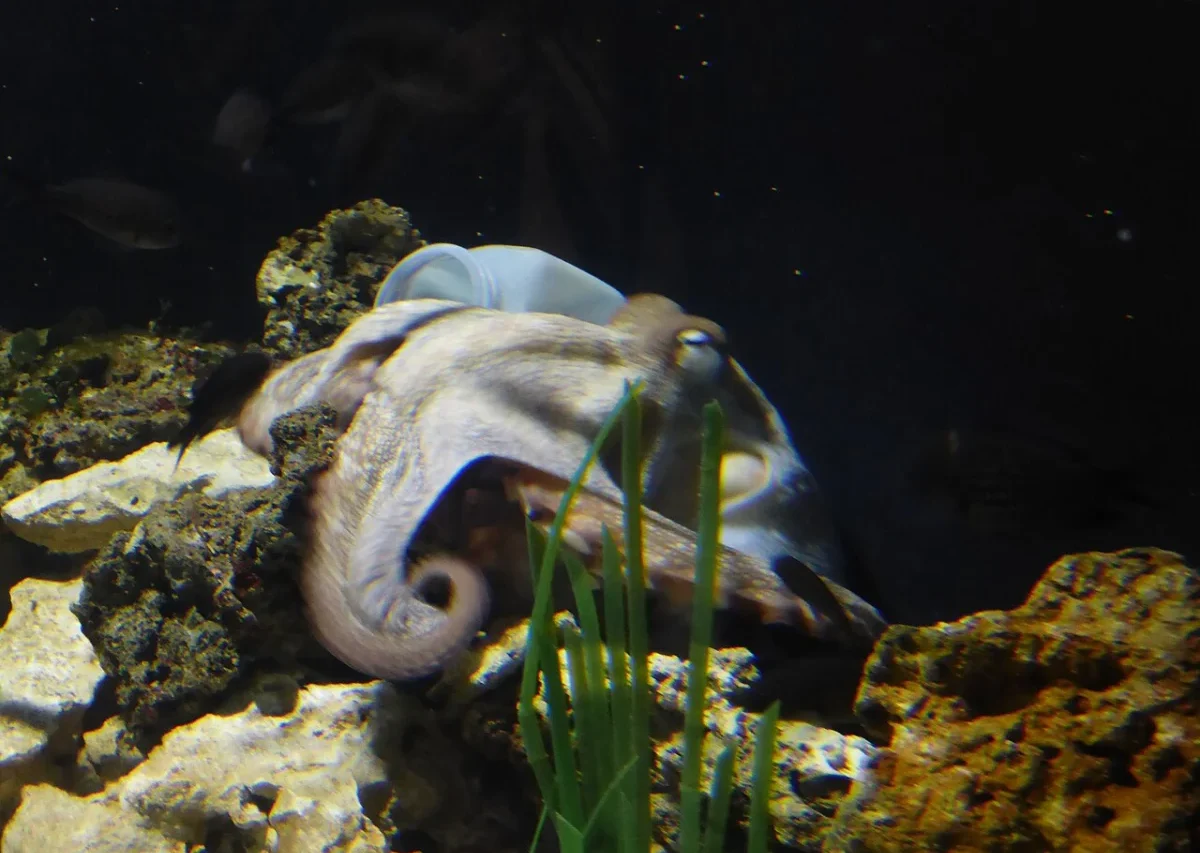
An octopus can carry awkward pieces of shell across the seafloor, then turn them into shelter when it needs cover. The animal is not merely holding a snack; it is moving a useful object through its world.
That act raises a striking question. What sort of mind can work through eight flexible arms, without bones or a body shaped anything like ours?
Octopus intelligence explained is a story about evidence, not a contest to crown the ocean's smartest creature. The strongest clues come from tasks with clear results, and from questions that remain open.
A mind built around a distinct body
The octopus nervous system includes a main brain and large networks in the arms. This setup helps a soft body sense and move. It does not mean eight separate human-like minds live in the limbs; the main brain and arm circuits share work in ways scientists are still tracing.
Start by setting your own body aside. You have joints that limit how your limbs bend, and hands that usually work near the end of fixed paths.
An octopus has far more freedom. An arm can reach, bend, curl, and change its shape while many suckers make contact with a surface.
That creates a control problem that our bodies never face in quite the same way. A system that handles every small action from one central point could be overwhelmed by the sheer range of options.
Local nerve circuits help with that work. The octopus nervous system spreads some tasks through the body rather than forcing all details through a single command room.
But a useful local circuit is not proof of a separate mind. Calling each arm a brain can give readers the wrong picture of eight clashing thoughts.
The better question is which jobs need guidance from the brain and which can run more locally. Scientists can then design tasks that separate those roles.
Octopus arm control is also a reminder that a mind belongs to a body in a place. A skill may look odd because the animal faces problems we barely notice.
Instead of asking whether it thinks exactly like a person, ask how it solves the problems that matter on its own patch of seafloor.
Arms search where the eyes cannot see
Octopuses use touch and chemical sensing when searching hidden spaces for food. Tests show that they can add a few arms to a task and often recruit neighboring arms. Their smooth movements show shared work, yet one test cannot trace each nerve signal that guides a search.
Picture a dark crack in a rock. An eye can guide an animal toward it, but cannot show what lies around its inner bends.
An arm can reach into that space and gather a new kind of information. Suckers encounter surfaces, objects, and chemical cues where a clear view is not possible.
In one study, scientists gave octopuses a covered structure containing an item. They tracked how the animals used and added arms during exploration.
The animals often used a few arms at once. A nearby arm was a common next recruit, though it was not the only option.
This beats a vague claim that an octopus has clever arms. The test gives a task and results that other teams can check.
It also leaves room for more than one explanation. A pattern in movement is not enough. It does not show where a choice formed within the octopus nervous system.
Octopus arm control becomes more interesting when we resist the neat slogan. Eight limbs can share work without acting like eight little people attached to a coat.
Learning leaves a trace after the task ends
Octopus learning has been tested through tasks involving places and objects. Some tests show that an octopus can remember a useful place after a delay and adjust when that place changes. These results support clear learning abilities without using one good result to rank the whole mind.
A safe place is valuable to a soft animal. Finding it once is useful; remembering it can save time on the next trip.
In a study of Octopus bimaculoides, scientists tested whether animals could learn the place of an open burrow. The animals learned the place and recalled it after a delay. They also learned a new spot when it changed.
That last step matters. A task that stays the same can reward a fixed routine, while a changed task asks whether the animal can update its actions.
Octopus memory should thus be discussed in terms of what was kept in mind and for how long. It is too vague to call every striking act proof of a perfect memory.
Other work has tested learned responses to real and screen-based objects. Such tasks help define what an animal can tell apart under controlled settings.
Sound octopus learning research separates claims from measured results. It gives us small, sturdy findings that can be linked together over time.
A memory of shelter may sound modest beside a tale of escape. For the animal, it can be the skill that makes tomorrow possible.
A coconut shell raises a harder question
Octopus tool use includes findings of animals carrying coconut shell halves and later arranging them as shelter. The carrying can be awkward and offers no immediate cover. This makes the act striking, while the mental process behind it still requires care: tool use alone does not prove human-style planning.
The seafloor does not come with a furniture store. A useful hollow object can serve as cover, if an animal can find and manage it.
Scientists observed octopuses gathering coconut shell halves, carrying them, and using them as shelter later. The trip with the shells required an odd, awkward way of moving.
The shells did not protect the animal while it carried them. That delayed benefit is part of what made the report about octopus tool use so notable.
It may tempt us to claim that the animal pictured the future just as we do. The finding does not show that full claim.
A learned link between an object and shelter could play a role. More than one mental route may produce the same useful act.
This is not a way to drain the wonder from the scene. It is a way to keep the question open long enough for a better test.
Even the cautious account is rich. A soft animal collects a hard object and turns part of the landscape into a tool it can move.
Its life gives it a problem, and its actions give that problem an answer.
A clever animal may also have experiences that matter
Research on octopus pain uses actions, choices of place, and nerve signals to test more than pulling away from harm. Findings support an unpleasant, lasting state, though we cannot read an inner state directly. They give us a reason to weigh the animal’s needs alongside its mental skills.
It is easy to focus on escapes, puzzles, and strange movements. Pain research asks a less entertaining but more important question about the animal behind those scenes.
Moving away from a harmful touch is not the same as proving an unpleasant feeling. Even simple systems can produce a quick reflex.
A study thus combined a few kinds of evidence. Octopuses avoided a place linked with a painful treatment and chose a place linked with relief. Other findings and nerve tests added support.
The findings suggest that octopus pain involves more than a brief reflex. They do not allow us to climb inside the animal's mind and report its experience in human words.
That gap is common in the study of other minds. We use tested actions and biology, then state how strongly they support a claim.
The result should change how we frame curiosity. A good question about intelligence is not merely, what trick can we make this animal perform?
It is also, what settings let us learn without ignoring the animal's needs? A soft body and a new mind are reasons for care, not reasons to assume nothing can matter to it.
Octopus intelligence explained ends without a human scorecard. The strongest picture is of a body that senses, learns, adapts, and may undergo states that deserve respect.
Frequently Asked Questions
These answers address common questions about this topic, with a focus on what the evidence supports and where it stops. They separate tested results from popular claims, so you can leave with a clear picture rather than a longer list of myths.
Do octopuses really have nine brains?
They have a main brain plus extensive nerve networks in their arms. The popular nine-brain phrase is a shortcut that can mislead; arm circuits are not known to be eight separate minds with separate human-like thoughts.
Can an octopus remember where it found shelter?
Spatial learning studies show that tested octopuses can retain a learned shelter place after a delay. The result concerns set tasks and species, not a claim that all octopuses have perfect memory.
Does using coconut shells prove future planning?
It shows a useful act with a later payoff. It does not settle how the mind reached that choice. We need to test learned links and other causes before we claim it plans like us.