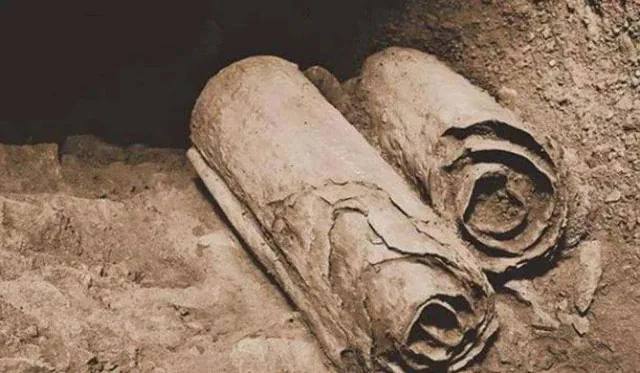
A torn piece of old leather can change how a whole book is read. Near the Dead Sea, fragments small enough to fit in a hand preserve words copied many centuries before most surviving biblical manuscripts.
Their power lies partly in how ordinary they are. A scribe worked line by line, and a reader once held the finished scroll without knowing it would become a modern treasure.
The Dead Sea Scrolls discovery brought those acts back into view. It also opened hard questions about who wrote the texts, who hid them, and how many voices survive within them.
The answer is not one lost book with one secret. It is a library of ancient writing, recovered in pieces from a dry and dangerous landscape.
The Find Began With Caves, Not a Planned Library Search
The first discoveries near Qumran came in 1947, when Bedouin found scrolls in a cave by the Dead Sea. More finds followed through exploration and excavation. The shepherd story captures the surprise of the discovery, but details of its earliest moments differ between accounts and should be treated with care.
The story often begins with a stone thrown into darkness and the sound of pottery breaking. It is an image that makes chance feel almost magical.
Yet the discovery did not end with one moment in one cave. Dealers, scholars, local people, and excavators all became part of the path from the desert to study rooms.
The scrolls changed hands during a period of major political upheaval. That history affects how their recovery and ownership are discussed today.
A Fragment Has a Journey Too
A manuscript removed from a cave loses some of its setting. Its position, nearby objects, and the layer of earth around it may be hard to recover later.
That context can be as valuable as the words. A document is not only a text; it is also an object left in a place for a reason.
The Qumran caves therefore matter alongside the pages found within them. Researchers need both the writing and the physical record to ask how the collection formed.
Chance opened the door. Careful work had to follow before the find could become knowledge.
There Was More Than One Kind of Writing
The scrolls include biblical manuscripts, religious commentaries, community rules, hymns, and other texts. Many survive only as fragments. Together they show a varied world of Jewish writing around the late Second Temple period, rather than one uniform set of beliefs or a complete ancient version of a modern printed Bible.
The phrase Hebrew Bible texts gives only part of the collection’s range. Some scrolls contain material familiar to readers today, while others preserve works outside modern biblical canons.
A commentary might connect a passage with the concerns of a community. A rule text might describe expected behavior, shared duties, or the order of life together.
Hymns offer another kind of voice. Their words can reveal ways people expressed hope, praise, and distress.
A Collection Is Not One Opinion
Modern readers sometimes search the scrolls for a single hidden message. That approach can flatten a diverse group of writings into something its makers never intended.
Think of a library that holds poems, laws, history, and arguments. The books share shelves without sharing one author or one point of view.
Ancient manuscripts deserve that same attention to difference. A rule in one text does not automatically describe every person who lived in the region.
The collection is valuable partly because it preserves variety. It lets us see debate and choice where a simpler story would show only one fixed tradition.
Why the Age of a Text Matters
The scrolls preserve biblical and other writing from many centuries before medieval manuscripts. Comparing them reveals both continuity and variation in how texts were copied. Their value does not rest on proving one claim; it lies in giving scholars earlier evidence with which to study the history of written traditions.
A copied book can remain recognizable while changing in small ways. Spelling, word choice, line order, and missing or added phrases all require study.
The scrolls give researchers a much earlier place to begin those comparisons. They show how a text existed before later copies became the main surviving witnesses.
That does not make every difference a scandal. Ancient copying was a human act, and human acts can leave patterns as well as mistakes.
Earlier Evidence Is Not a Magic Verdict
An old manuscript is important because of what it preserves. Its age alone does not settle every question about authorship, theology, or historical events.
A passage may be old while referring to something older still. The date of a copy is not automatically the date of its first composition.
Nor does a change in wording mean the whole tradition was unstable. Researchers look at the size and nature of a difference before deciding what it changes.
The most interesting story may be quiet continuity. A line copied across centuries can be as striking as a phrase that appears in a different form.
The Desert Saved the Scrolls, but Not Without Loss
Dry conditions in the Judean Desert helped preserve material that often decays elsewhere. Even so, many scrolls were damaged, fragmented, or incomplete. Their condition reflects ancient storage, later exposure, and handling, so the surviving collection is not a complete sample of everything once written or kept in the region.
Leather and papyrus are not stone. Moisture, insects, and rough use can destroy them long before a future reader arrives.
A dry cave can reduce some of those threats. Storage vessels and the local environment may also affect what survives.
But survival comes in degrees. A scroll can preserve whole lines in one area and almost nothing in another.
Scroll preservation therefore involves more than keeping an object in a case. Light, temperature, humidity, support, and handling all need care.
The Missing Parts Shape the Reading
A gap in a line can leave several possible words. The strongest restoration must fit the visible marks and the wider text, not merely the reader’s preferred meaning.
Fragments can also be difficult to place. Two pieces may look similar while belonging to different manuscripts or different copies of the same work.
Modern imaging can make faint writing easier to study without asking everyone to handle the object. Digital access also lets scholars compare material across collections.
None of those tools can restore a missing piece with certainty just because a computer makes the guess look neat. Technology improves the view; it does not remove the need for judgment.
What the Scribes Leave Us to Think About
The manuscripts preserve skilled copying, reading, and varied religious life. Their relationship to the nearby settlement remains debated, so one simple ownership story cannot explain every text. Studying the collection as evidence of human activity allows differences between documents to matter, rather than forcing them into a single lost message.
Ancient scribes worked within physical limits. A writing surface had edges, a line had space, and a hand could grow tired.
Their choices appear in letter shapes, corrections, and the way a page was arranged. Those details bring a real person closer than a broad label can.
A reader today may focus on the message alone. The object asks us to notice the work needed to keep that message available.
A Library Made of Survivals
The Dead Sea Scrolls discovery is often described as a sudden light thrown onto the ancient world. The better image may be many small lights, each showing part of a larger room.
A hymn shows one kind of language. A legal text shows another, and a copied biblical passage adds an earlier witness to a familiar tradition.
The gaps remain, but they need not spoil the experience. They help us keep the surviving words in proportion to the much larger world that produced them.
What returns from the caves is not a perfect explanation of the past. It is a chance to listen more closely to people whose work almost vanished.
Frequently Asked Questions
The scrolls are often surrounded by claims about hidden secrets, lost books, and dramatic changes to religious history. Their real value is richer and more lasting. These answers distinguish the manuscripts’ age and contents from claims that go beyond what a fragment, a cave, or a copied passage can prove.
Are the Dead Sea Scrolls the same as the Bible?
The collection contains biblical manuscripts and many other kinds of writing. It is not one complete book matching a modern Bible in content and arrangement.
Who wrote the Dead Sea Scrolls?
The manuscripts were produced by many scribes, and their exact origins vary. Scholars continue to discuss how the collection relates to groups in the region and the settlement at Qumran.
Can a scroll fragment be read without touching it?
High-resolution and multispectral imaging can reveal writing and support remote study. The physical object still needs expert care, because digital access does not replace conservation.