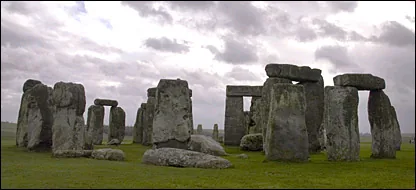
A stone joint at Stonehenge looks like something a carpenter might have made. One block has a raised knob, and the stone above it has a matching hollow.
The builders used that fit to hold a huge piece of rock in place. Their work was not a lucky pile of stones, and it did not need visitors from another world.
Stonehenge builders left no signed plan. What survives is a landscape of homes, graves, tools, and careful choices made over many generations.
Look beyond the famous circle and the story grows richer. The real mystery is not whether people could build it, but how their communities found the time, food, and shared purpose to keep doing so.
A Monument Built Across Generations
Stonehenge developed through several stages, rather than appearing as one finished circle. An early earthwork enclosure came before the stone settings, and later people moved and rearranged stones, while the surrounding landscape gained more monuments. Its present form preserves parts of a long process of change and use.
The first major enclosure dates to about 3000 BC. A ditch and bank marked a special space long before the large stones gave the site its familiar shape.
Digging that ditch still demanded work. People needed tools, a place to put the soil, and a reason to return when the task became tiring.
Later builders added stones of different kinds and sizes. Their choices changed the monument without erasing everything that came before.
This matters because a single date can make Stonehenge seem easier to explain than it is. The people who began it did not leave the same structure that later generations used.
Why One Builder Story Is Too Small
Imagine a church altered over hundreds of years. A new tower, a changed entrance, and a rebuilt roof can belong to different groups with different aims.
Stonehenge calls for the same patience. Neolithic Britain was not frozen in one moment while people waited for the circle to be finished.
Homes changed, communities moved, and older places gained new meanings. The monument lived within that changing world.
A modern reconstruction can show how a task might have worked. It cannot turn many generations of people into one crew with a single foreman.
The Stones Came From Different Landscapes
The monument includes large sarsen stones and smaller bluestones with different geological origins. Research links much of the sarsen material to southern England and several bluestones to Wales. Some stones have more complex histories, so identifying their sources does not provide one simple route or transport method for them all.
Sarsen stones form the huge uprights and crosspieces that catch the eye first. Their bulk makes the work of moving them hard to ignore.
The Stonehenge bluestones are smaller, but their varied origins open another set of questions. A stone chosen far from the site had to mean enough to justify a long journey.
Tracing rock to a source requires more than spotting a similar color. Researchers compare its structure and chemical traits with samples from possible locations.
As methods improve, a source that once seemed obvious can become doubtful. That is how a living research question works.
A Source Is Not a Travel Diary
If a stone came from Wales, that tells us where the rock formed. It does not, by itself, reveal every path people used to bring it east.
Land routes, water routes, and the practical demands of loading a heavy object all deserve attention. The evidence is stronger for some parts of the story than others.
The large Altar Stone also shows why old summaries can age poorly. Research has challenged earlier ideas about its origin, widening the map of places involved.
That does not make the monument less human. It makes the network of people and places behind it more remarkable.
The Building Site Needed Food Before It Needed Fame
A large construction effort depends on feeding people and moving stone. Evidence from Durrington Walls, near Stonehenge, includes houses and animal remains linked to gatherings. The settlement helps researchers explore the communities behind the monument, although it does not tell us each worker’s exact job or length of stay.
The homes at Durrington Walls bring the builders out of the mist. They suggest real hearths, meals, and people who needed somewhere to sleep.
A heavy haul begins with ordinary work elsewhere. Someone grows grain, someone tends animals, and someone prepares the food that keeps a team moving.
A community that brings people together must also deal with waste. Bones, broken pots, and worn tools become clues long after the meal or task is done.
The finds point toward a social world far larger than the stone circle. They let us ask who traveled, what they brought, and when gatherings took place.
Cooperation Leaves Uneven Traces
Prehistoric engineering was partly an engineering problem and partly a human one. A rope can pull only if enough people agree when to pull it.
But a strong effort does not prove that everyone took part by free choice. Nor does it prove that one ruler forced all the work.
The evidence cannot give us a complete chart of authority. We should avoid filling that blank with the system that feels most familiar today.
Food remains offer firmer ground. They can show that people met and ate, even when the rules that brought them together are lost.
How People Could Raise a Giant Stone
Stonehenge’s worked joints, shaped surfaces, and stone holes show deliberate planning. Human crews could use ropes, timber, packed earth, and controlled movement to lift and secure heavy stones. Experiments test these methods, but more than one practical approach may fit the evidence, and the original sequence remains partly uncertain.
A giant upright did not have to be lifted straight up from flat ground in one move. A prepared hole gave builders a way to turn its own weight into part of the process.
A team could guide one end toward the hole while controlling the stone’s angle. Timber and ropes could help prevent a sudden drop.
Once the upright stood, the hole needed packing. A tall block that rocks on loose soil is dangerous to the people setting the next piece.
The crosspieces added a harder task. Builders had to bring stone above other stone without modern cranes.
The Details Reveal Skilled Hands
The fitted joints matter because they show that shape was part of the design. The builders were solving a problem of fit, movement, and long-term stability.
Their tools were not our tools. They still understood that a surface, an edge, and a joint could make a structure behave in a certain way.
An experiment with a stone replica can test how many hands or how much force a method needs. Its value lies in testing a possibility, not declaring the whole mystery closed.
There is a quiet dignity in that distinction. We can admire their skill without claiming we have recovered every step of their work.
The Sun Mattered, but It Was Not the Whole Story
Solstice alignment is a part of Stonehenge, with key features relating to the sun’s seasonal positions. The site also contains evidence of burial and use. These roles can coexist, so it is misleading to treat the monument as only a calendar, only a graveyard, or only a place of worship.
A low winter sun could give the stones a meaning different from the one they held on a bright summer morning. The cycle of light was part of the world people knew by watching.
They did not need a phone calendar to notice the seasons. Food, weather, travel, and farming made the year’s changes impossible to ignore.
Still, an alignment does not tell us the full belief behind it. It shows care in how the monument met the sky.
Burials and nearby monuments add other layers. People could gather around the dead while also marking a change in the year.
Reading the Landscape With Care
The best visit begins before you reach the center. Banks, tracks, and distant mounds help show that Stonehenge belonged to a wider place.
Its builders did not stand in the empty postcard scene we often imagine. They lived among paths, homes, animals, and older memories.
That wider view is the real reward of studying Stonehenge builders. The circle becomes less like a puzzle dropped from the sky and more like a choice made within human lives.
The stones keep their wonder. What changes is who we allow to deserve the credit for putting them there.
Frequently Asked Questions
Stonehenge is best understood through separate kinds of evidence, from rock sources to settlement remains and the monument’s own structure. No single clue supplies the entire building story. These answers explain what researchers can reasonably say about its makers, its stones, and the later legends attached to the site.
Did the Druids build Stonehenge?
The main construction stages predate the Druids known from later written records. Modern Druid connections belong to the monument’s later history, not proof of who raised its original stones.
Were all the stones brought from Wales?
No, the large sarsens and the bluestones have different origins. Research also continues to refine the sources of individual stones, including the Altar Stone.
Do we know exactly how the stones were moved?
Researchers have tested workable human methods using ropes, timber, and organized crews. Those experiments show what was possible, while leaving parts of the actual route and process uncertain.