The hikers left their tent in winter darkness, and the question followed them for decades. What could make experienced people abandon shelter on a cold mountain slope?
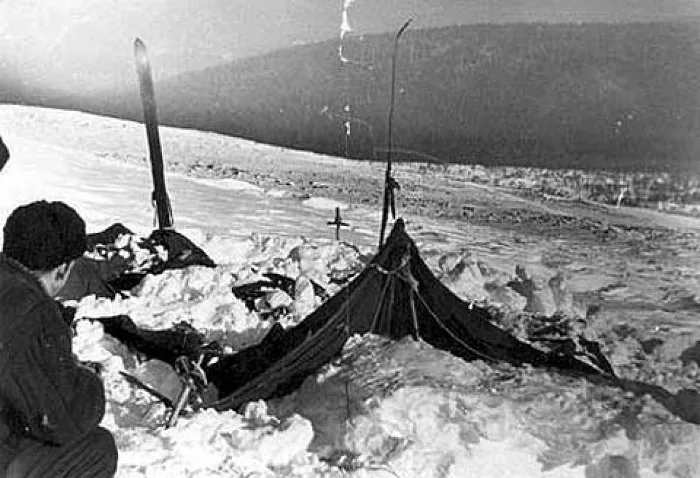
Nine members of a Soviet hiking group died in the northern Urals in 1959. Their damaged tent, scattered remains, and severe injuries became the pieces of a story that many retellings made stranger with every year.
The Dyatlov Pass avalanche explanation does not claim that every minute can be reconstructed. It asks whether a natural snow event could account for features once treated as proof that ordinary causes were impossible.
That is a different kind of mystery story. It begins by taking the victims seriously and testing the landscape, rather than making the most disturbing detail carry the whole answer.
The Tragedy Began With a Winter Expedition
The group was traveling through the Ural Mountains when nine hikers died near their mountain camp. Another member had turned back earlier because of illness. Searchers found the tent and bodies in separate places, creating a reconstruction based on incomplete evidence, harsh conditions, and discoveries spread over an extended period.
The 1959 hiking tragedy was not a carefully observed experiment. No instrument recorded every movement at the campsite or the full state of the snow.
The surviving evidence entered the investigation through search work. Some remains were found earlier than others, and winter conditions shaped access to the site.
A person looking back therefore sees the event through several layers. There is what happened, what the searchers found, what investigators recorded, and what later writers chose to emphasize.
Keep the Layers Apart
The Dyatlov tent became famous because its damage and the apparent departure raised urgent questions. Those questions did not come with one immediate explanation.
A reconstruction has to consider the location of each item and the time between the event and its recovery. Snow, exposure, and later disturbance can change what a site preserves.
That does not make the record worthless. It means the limits of the record belong inside the explanation.
A confident story told without those limits can be easier to follow and harder to trust. The mountain does not owe us a complete sequence just because the tragedy is compelling.
A Slab Avalanche Is Not Always a Huge Visible Snowfield
A slab avalanche releases a cohesive snow layer above a weaker one. It can be smaller and less obvious than the huge slides familiar from films. Modeling considers local slopes, a campsite cut, and later loading, showing why a limited snow event could still threaten people sheltered below it.
The word avalanche brings a dramatic image to mind. We picture a mountain sending a vast white cloud down its whole face.
Snow mechanics includes smaller events. A slab can fail across a limited area while still placing dangerous force on people and equipment below it.
The critical question is not whether a photograph resembles a disaster film. It is whether the slope, layers, and loads could support the proposed event.
A Gentle-Looking Slope Can Hide Local Conditions
A broad view may not reveal the angle at every point. A cut in the snow, an uneven surface, or a concealed change in terrain can matter.
The hikers’ choice to make a platform for the tent may also affect a model. Removing support from part of a snowpack can change how the layers behave.
That is not an accusation that the group knowingly caused its own deaths. It is an attempt to understand a hazard that can be difficult to judge even for experienced travelers.
The natural setting is complex enough to deserve careful testing before it is declared incapable of producing danger.
Why a Delay Does Not Rule Out Snow Failure
A campsite cut need not trigger immediate failure. Wind can add snow later, increasing the load until a slab releases. Published modeling explored that delay as a response to one objection to the avalanche account, without claiming to recover every weather condition or human action from the night.
A delay can make a cause look disconnected from its effect. If the snow seemed stable when the tent was set up, people may assume it had to remain stable later.
A mountain is not a fixed surface. Wind moves loose snow, and a layer can gain weight while campers are no longer watching the slope.
A model can test whether that change is enough to alter the balance. It does not have to invent a second, unrelated cause merely because some time passed.
What a Model Actually Provides
A scientific model explores conditions under which an event could occur. Its strength depends on the data, assumptions, and whether its results match relevant observations.
It is not footage from the night. A successful model does not identify every hiker’s action or remove every uncertainty from the record.
That distinction helps us judge the Dyatlov Pass avalanche proposal fairly. It can answer a physical objection without claiming to solve the entire human sequence.
The useful advance is narrower and stronger: a delayed snow event can be tested rather than dismissed simply because a familiar picture of an avalanche does not fit.
Injuries Need Context, Not Just a Shock Value
Severe injuries need to be assessed against pressure, exposure, and the conditions in which remains were recovered. Modeling has tested possible trauma from a small snow slab. Missing soft tissue also needs postmortem context, rather than being treated automatically as proof of violence or a mysterious attacker.
A list of injuries can sound like a complete crime scene. It becomes less simple when bodies were exposed to cold, snow, water, and the passage of time.
A missing feature may have a postmortem explanation. A serious internal injury may come from force without matching the marks a reader expects from a fight.
Those possibilities do not prove one reconstruction. They show why a disturbing detail cannot be separated from its physical setting and used as a verdict.
The Victims Deserve More Than a Puzzle Box
The hikers had names, skills, friends, and plans. They were not created to provide a collection of frightening clues.
That should affect how their deaths are described. Graphic emphasis and supernatural claims can turn an effort to understand into a spectacle.
A respectful account still asks hard questions. It simply avoids using uncertainty as permission to say whatever makes the story more intense.
The evidence may leave a gap, but the people should not disappear into that gap. The central fact remains a real group lost in a dangerous winter environment.
A Plausible Natural Account Is Not a Perfect Reconstruction
Avalanche research offers testable mechanisms for delay and serious injury, supporting a natural account of important features. It doesn’t supply a complete sequence of the hikers’ movements. A plausible physical explanation and remaining uncertainty can coexist when the surviving record is too limited to reconstruct every minute of the event.
Winter survival depends on shelter, warmth, visibility, and the ability to make choices under pressure. Losing one part of that system can make the others harder to preserve.
If a group believed the tent area was unsafe, moving away could make sense at the moment. The later danger of exposure would not necessarily be clear in the same way.
A reconstruction must allow for that difference. People react to what they think is happening, not to a summary written years afterward.
The Better Question Is What the Evidence Can Select
Many theories can be made to sound possible. A useful explanation earns its place by fitting observations and using mechanisms that can be examined.
The snow research does that work for important parts of the tragedy. Its remaining limits should invite further study, not a return to treating all stories as equally supported.
Dyatlov Pass avalanche is therefore a phrase about a tested explanation, not a claim that the mountain has surrendered every secret.
The most honest ending keeps both points together. Ordinary natural hazards can produce extraordinary loss, and a careful investigation may still leave parts of a night beyond recovery.
Frequently Asked Questions
The case became famous through objections to explanations, many of which depend on a simplified picture of snow and injury. These answers describe what avalanche research has addressed and what it has not. They preserve the distinction between a plausible physical mechanism and a reconstruction of the hikers’ final movements.
Has the Dyatlov Pass case been completely solved?
Research supports a physically plausible avalanche explanation for important features of the tragedy. The evidence still does not recover every action and condition from the night.
Was the slope too gentle for any avalanche?
A broad visual impression is not enough to decide local snow stability. Researchers have considered uneven terrain, weak layers, a campsite cut, and wind-driven loading in their models.
Do the injuries prove an unknown attacker was involved?
No, an injury must be assessed against pressure, exposure, recovery conditions, and other evidence. Disturbing details alone do not establish violence by an extraordinary or unidentified attacker.