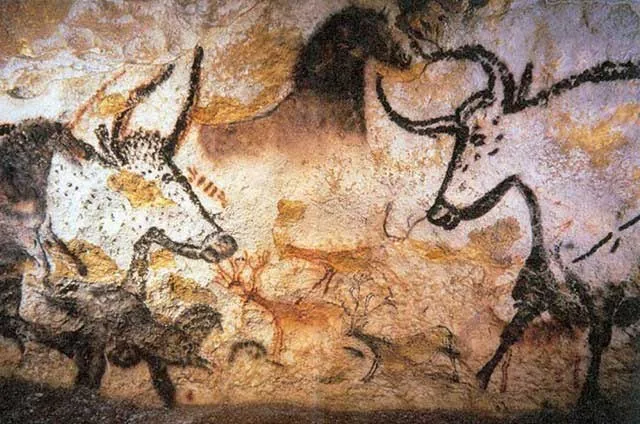
The animals seem to move before your eyes. A horse leans forward, a bull fills the wall, and the rock bends beneath the painted body as if it belongs there.
These are not rough marks left by people who had only just learned to notice beauty. Lascaux cave paintings show careful choices about line, color, space, and the surface of the stone.
The artists lived in a world without written books. Yet in the dark beneath a French hillside, they made images that still feel full of life.
Their reasons remain harder to read than their skill. That gap makes the cave more moving, because it asks us to look closely without pretending that every ancient choice has a modern answer.
The Discovery That Opened a Hidden World
Lascaux became known to the modern world in 1940, when young people entered the cave near Montignac in southwestern France. Its walls revealed a rich collection of Ice Age images. The discovery changed public ideas about prehistoric art, showing that skilled and complex picture-making had deep roots in human history.
An opening in the ground is easy to pass without much thought. It may look like a place for roots, stones, or a small animal to hide.
At Lascaux, that ordinary-looking entrance led to a world that had remained out of sight. The first visitors needed light to see what waited beyond it.
Ice Age artists had used the cave as more than a blank room. They worked with shapes and spaces that could guide the eye or limit where a person stood.
A Find Changed the View of Prehistory
It is tempting to picture early humans as people occupied only with the next meal. Food and shelter mattered, but the cave shows that their lives also held acts we cannot reduce to survival alone.
An image takes time to plan and make. A person must gather material, find a surface, bring light, and decide what to show.
The paintings do not prove that their makers had our idea of an art gallery. They do prove that human attention reached far beyond the things a person could hold or eat.
That is a larger story than a tale about people making pretty marks on a wall.
The Animals Were Not a Simple Hunting Menu
The painted animals at Lascaux include horses, large wild cattle, deer, and other creatures. Their presence does not make the cave a direct record of every meal. Researchers compare the images with other archaeological evidence, because animals important in art need not be the same animals most often eaten.
The Hall of the Bulls takes its name from some of the cave’s most famous figures. Their scale gives the room a force that a photograph can only partly convey.
A large animal occupies both the wall and the viewer’s attention. Its outline can make the space feel crowded even when no living creature is there.
Horses appear with strong curves and sure lines. The makers understood how to suggest a body without drawing every hair or muscle.
Some figures overlap. That can suggest repeated visits and additions, although the order and meaning of every mark remain difficult to settle.
Familiar Shapes, Lost Meanings
We can recognize a horse without knowing why someone chose that horse. The same is true of the signs painted near animals.
A group of marks might have carried meaning within a community. That meaning may have depended on stories, shared rules, or knowledge that was never written down.
There are many ideas about why people made Paleolithic art. Hunting beliefs, teaching, social gatherings, and ritual have all entered the discussion.
No single explanation fits every cave and image neatly. A careful reading makes room for more than one use, rather than turning all ancient artists into people doing the same thing.
Paint, Light, and the Shape of the Rock
The artists used mineral-based colors and methods that included drawing, painting, and applying pigment in different ways. Natural curves in the walls could help suggest an animal’s body. Working underground also required light, making the finished images part of an experience shaped by darkness, movement, and the cave itself.
Prehistoric pigments came from materials people could find and prepare. A useful color still needed the right texture and a way to reach the stone.
Making paint is a chain of small choices. Grinding, mixing, storing, and applying it can change how a line looks and how well it stays in place.
The wall was not flat paper. Its hollows and ridges offered advantages as well as problems.
A curved surface could give an animal volume. A crack could interrupt the outline or suggest a feature that the painter chose to use.
What Moving Light Might Change
Imagine a lamp casting light across a painted wall. As it shifts, the shadows change and the surface becomes easier or harder to read.
That is a useful way to think about the setting, not proof of a planned ancient light show. We do not need to invent a performance to recognize that light affected what people could see.
The dark also changes the work of the artist. Materials and tools must be brought inside, and a person cannot simply rely on the sun overhead.
Those practical demands make the paintings feel more deliberate. They were not idle marks made while someone happened to wait in a bright room.
Why Visitors Became a Threat to the Paintings
Opening Lascaux to large numbers of people changed conditions inside the cave. Heat, moisture, carbon dioxide, and other pressures threatened its fragile environment. The original cave was closed to regular public visits in 1963, and conservation has required ongoing care as researchers work to protect the paintings from further damage.
A cave can seem solid and timeless while remaining highly sensitive. Its air, water, and living organisms respond to changes that a visitor may barely notice.
People bring warmth and breath into a confined space. Lighting and building work can add new pressures.
For paintings that survived under particular conditions, a small change may have serious effects. The problem is not simply that someone might touch a wall.
Cave conservation has to look at the whole environment. Moisture, temperature, surface growth, and the movement of air can all matter.
Seeing a Copy Can Protect an Original
Replica sites let visitors experience the images without filling the original chambers. That may sound less exciting than stepping into the real cave, but it serves a clear purpose.
There is also a useful lesson in the choice. Preservation sometimes means accepting a limit on our own wish to stand as close as possible.
How to Look Without Turning Wonder Into a Guess
Lascaux is strongest as evidence of skill, image-making, and human engagement with animals and place. Its precise beliefs remain uncertain. A thoughtful viewer separates what is visible from what is inferred, while still appreciating the care that went into images made long before written explanations could preserve their meaning.
Start with the line. Notice where it thickens, where it follows the rock, and where a body is suggested with only a few strokes.
Then look at scale. Ask why one animal takes up so much space and another seems small beside it.
Those questions keep your attention on something that actually survives. They are more useful than trying to name a lost ceremony from one symbol.
Ancient animal paintings can carry wonder without giving us a neat story about their makers. We can respect an artist while admitting that their reasons remain partly out of reach.
The Human Link Is Already There
Someone stood in the cave and chose a mark. Another person may have seen it later and understood something we no longer know.
We cannot recover that whole exchange. Yet the care in the image makes it hard to think of the maker as a distant, simple figure.
Lascaux cave paintings narrow the gap in a different way. They show that people long ago could study a living body, notice its force, and turn that attention into an image.
The wall does not tell us everything. What it tells us is enough to change how we picture the people who stood before it.
Frequently Asked Questions
Lascaux raises questions about the age, meaning, and care of prehistoric images. Researchers can describe the artwork and its setting more confidently than they can recover every belief behind it. These answers focus on the difference between what the surviving cave shows and what remains a reasonable but uncertain interpretation.
How old are the Lascaux cave paintings?
They were made during the Upper Paleolithic, broadly around seventeen thousand years ago, with dating and chronology still discussed in research. They belong to a deep tradition of prehistoric image-making, not the beginning of all art.
Can tourists enter the original Lascaux cave?
The original cave is not open for ordinary public tourism. Visitors can see detailed replicas designed to share the images while protecting the ancient environment.
Do we know why the paintings were made?
No single purpose has been proved for all the images. Their skill and subject matter are clear, while ideas about ritual, learning, and social meaning remain matters for careful study.