A rich island empire disappears in a single day and night. Its ships, temples, and proud rulers vanish under the sea, leaving a story that people still treat like a treasure map.
But the strangest thing about Atlantis is not its sudden fall. Our source is a philosopher who asks how people should live.
Here is the Atlantis myth explained through the story Plato actually told. We will separate his words from later guesses, follow the appeal of his island, and ask why a tale about power keeps turning into a hunt for ruins.
Where the Story Begins
Atlantis enters the old written record through Plato’s dialogues, not through a recovered map or a ship’s log. His speakers describe an old war, a vast island, and a chain of old stories. That literary setting matters whenever someone presents the tale as plain history.
The two key works are Timaeus and Critias. Read together, they show a talk among people who are exploring ideas about the world, society, and human conduct.
In the first work, a speaker named Critias tells a tale said to come through the Athenian lawgiver Solon. Solon, within that story, heard it from Egyptian priests.
The account then passed through family memory before reaching the group of speakers. That chain creates a sense of age and weight. But it is part of Plato’s story, not a separate Egyptian record.
A story inside a talk
This gap is easy to miss. An ancient author can have a speaker insist that a tale is true without supplying evidence that modern historians can check.
Plato and Atlantis belong in that same close study of story framing. We know the texts exist; we do not have the chain of earlier documents that their speaker describes.
Instead of asking only where an island stood, we can ask why Plato needed an island empire in this talk.
The answer starts with Athens, the city often pushed into the background. In Plato’s telling, its ancient people matter as much as the rich enemy across the sea.
The Island That Makes Readers Want a Map
Plato gives Atlantis rings of land and water, royal buildings, busy routes, and striking wealth. These details make the island easy to picture and hard to forget. Yet a vivid account can serve a story’s purpose without proving that the place once existed.
In Critias, Poseidon has children with a mortal woman named Cleito. The god surrounds her home with rings of land and sea.
From that start grows a royal center. Later rulers build bridges and canals, turning the rings into a setting for travel, trade, and displays of power.
Picture the layout as a reader, rather than as an eyewitness. Water cuts through the city, traffic flows toward its heart, and a sacred center rises above the works of daily life.
Plato adds costly goods, temples, and rich soil. These are story details that help readers feel the reach of the empire.
Wealth you can almost touch
The lost city of Atlantis appeals to us because its riches seem so concrete. A ring of water is something we could trace; a canal is something we could dig up.
That is also where reading can become wishful thinking. The more sharply an author draws a place, the easier it becomes to confuse a clear account with outside proof.
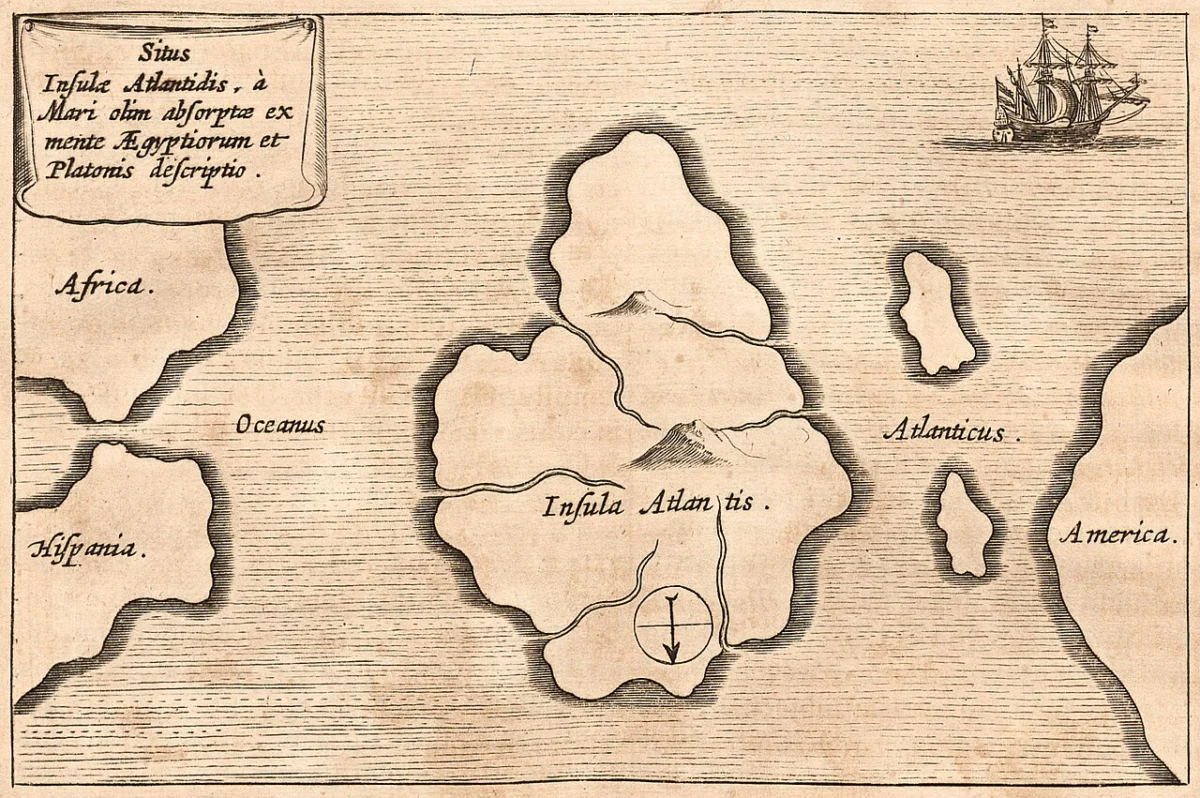
The place is another famous clue. Timaeus places the island beyond the Pillars of Hercules, the ancient name commonly linked with the Strait of Gibraltar.
The island’s scale and distant age make the account grand. They also make loose matches to a small ruin or a known coastal disaster much harder to defend.
Why Athens Is the Real Test
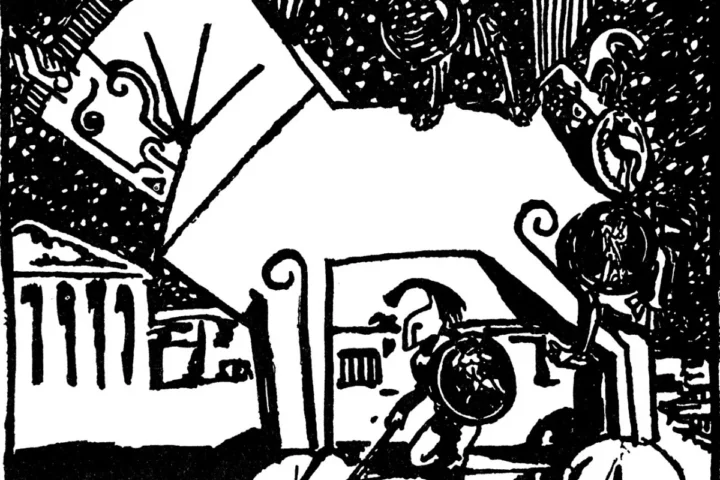
In Plato’s account, ancient Athens defeats a larger, richer invading power. The contrast turns the war into a test of conduct and civic order. Atlantis supplies the impressive opponent, while Athens shows the qualities the work wants its readers to notice and consider.
Modern artwork often makes Atlantis look like the hero: graceful towers, bright water, and tools beyond its age. Plato’s contrast makes a darker point.
His ancient Athens has skilled citizens and a social order fitted to its role in the story. Its strength is not simply the size of its fleet or the shine of its temples.
Atlantis, by contrast, grows into a hostile force. The island’s reach matters because it raises the stakes of the conflict.
Here ancient Greek philosophy becomes more useful than a metal detector. The question is how a group uses strength, not only how much strength it owns.
When success changes the rulers
Critias describes a decline in the rulers’ conduct. As the divine element in them weakens, their human failings become more visible.
They have wealth. But they no longer handle wealth well. A reader can hear a warning about appetite, pride, and the limits of outward success.
A palace can grow more splendid while the judgment inside it grows worse. That is a human pattern, not a secret message that requires a lost continent.
The unfinished Critias makes the experience even stranger. Zeus is about to address the gods when the surviving text stops, leaving readers at the edge of a speech they never hear.
What Would Count as Evidence?
Atlantis evidence needs more than a match between a ruin and a sentence in Plato. A strong case would require a secure date, a fitting place, and independent support for the claimed connection. Finding a real ancient disaster does not prove which island Plato meant.
People often point to a flooded town or a volcanic eruption and ask whether it could be Atlantis. The question can be interesting, provided we keep chance separate from proof.
A coast can change. A town can sink, and a city can burn. Those events are part of real human history without being evidence for this given empire.
The problem with flexible matches
Suppose a proposed site fits the rings but not the place. Someone may answer that Plato changed the geography.
If it also misses the date, the next answer may be that a number was copied badly. Soon nearly every mismatch becomes a reason to rewrite the source.
That approach can make almost any place seem promising. A good test should risk failure, rather than allow every objection to become another escape route.
The same caution applies to striking underwater images. Straight lines may deserve study. But a photograph alone cannot establish a city’s age, builders, or identity.
Ask who collected the data, how the site was dated, and whether other experts can inspect the findings. Also ask whether the argument begins with archaeology or begins with a desired answer.
That habit protects real discoveries. They deserve to be understood on their own terms, even when their true story turns out to be more modest than a famous legend.
Why We Still Look for the Lost Island
Atlantis lasts because it joins two powerful ideas: a hidden world waiting to be found and a successful society that can still fail. The first invites adventure. The second feels personal, especially when readers recognize pride, waste, or poor judgment in their own time.
A vanished island offers a perfect shape for a mystery. The sea conceals the evidence, and the story gives us enough detail to feel that discovery might be close.
Yet Timaeus and Critias offer another kind of discovery. They let us see how a story can carry a question about public life across many centuries.
The rulers of a rich society may think their position is secure. Their readers know that wealth and wisdom are distinct things.
That gap creates tension even before the sea rises. It also gives the story a force that a list of ancient buildings could never match.
Read the source before the theory
If you want to investigate further, start with the dialogues themselves. Notice when a speaker is reporting a tale, when Plato describes a place, and when the text turns toward judgment.
Then read any claimed site with those details in mind. Does it explain the whole account, or only the features that look useful?
You do not need to choose between enjoying a legend and caring about evidence. The pleasure lies partly in noticing how the mind and history pull in distinct directions.
Atlantis can remain a marvelous story without becoming a confirmed place. Its most lasting treasure may be the question waiting under all that water: what makes a society strong enough to use its power well?
Frequently Asked Questions
These questions focus on the line between a powerful story and the evidence behind it. The short answers explain what researchers can support, what ancient writers actually describe, and which tempting claims still need proof before we can treat them as established facts.
Did Plato claim Atlantis was a real place?
Plato gives a speaker an account presented as an old, true story. That written claim is not outside proof, and no securely identified site of ancient remains establishes the island empire he describes.
Is Atlantis described in the Republic?
The island story appears in Timaeus and Critias. Its political themes can be read alongside Plato’s other works. But the Republic is not the main source for its rings, rulers, or destruction.
Could a real disaster have inspired Atlantis?
A real disaster could have influenced a writer’s tale. But that chance does not prove which event he used. A given claim needs evidence connecting the event to Plato’s account, rather than a loose match.
Sources and further reading
This article draws on the records and research linked below. They let you check key facts, compare interpretations, and follow questions that remain open. The topic inspiration is credited separately from the sources used for the historical or scientific explanation.
- Plato, Timaeus, translated by Benjamin Jowett; public-domain text
- Plato, Critias, translated by Benjamin Jowett; public-domain text
Topic inspiration: KhoaHoc.tv. Independently researched and written for Relic & Riddle.