The ship was gone, but its outline remained in the soil. Rows of iron rivets marked a vessel large enough to carry an extraordinary burial, while the wood itself had long since decayed.
Inside the mound lay objects that changed the picture of early England. Gold, garnets, silver, and skilled metalwork spoke of wealth, travel, and hands trained to make things of rare beauty.
The Sutton Hoo ship burial did not reveal a king with a readable name tag. It offered something more demanding: a rich set of clues without a simple answer to every question.
Its story begins with people who chose to look closely at a field. It ends by changing what an age often called dark can look like.
A Mound Became a Ship Through Careful Digging
In 1939, excavation at Sutton Hoo in Suffolk revealed a large early medieval ship burial. Landowner Edith Pretty asked Basil Brown to investigate the mounds, and a wider team later joined the work. The find depended on recognizing delicate traces in soil, not just recovering objects that glittered when uncovered.
A ship can leave a shape after its timber disappears. Rivets, stains, and changes in the soil help turn an empty-looking space into evidence of a structure.
That makes excavation a kind of reading. The page is earth, and a careless movement can remove a line that no one can put back.
Basil Brown‘s work helped reveal the vessel beneath the mound. The care involved deserves more attention than the image of a lucky person striking gold.
The Landowner Had a Role in the Discovery
Edith Pretty made the investigation possible by taking an interest in the mounds on her land. Her decision placed a question before people who could study it.
The discovery soon drew expert attention. Different skills became necessary as the burial’s size and importance grew clearer.
That wider effort matters when the story is retold. A famous find can acquire one heroic name even though many people helped preserve and understand it.
The ship and its objects needed that cooperation. Their value would have been smaller if the excavation had left the evidence badly recorded or broken apart.
Treasure Revealed a Connected World
The burial’s fine objects and materials reveal wide connections through trade, gifts, and power. They challenge an isolated view of early England, but an imported item doesn’t identify its entire journey. Researchers compare material, style, and context before choosing between routes that could have brought it to the grave.
Anglo-Saxon treasure is easy to describe as a pile of valuables. At Sutton Hoo, that description misses how much each piece can say.
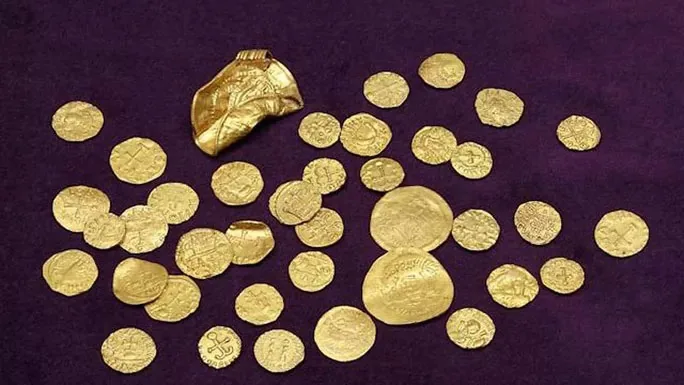
A silver vessel can point beyond England. Gold coins can help place the burial in time, while fine metalwork shows the value attached to skilled makers.
Some objects carried practical uses. Others expressed rank, belief, or a person’s place among those who shared a feast or fought beside a leader.
A Rich Object Can Hold Several Stories
A bowl made far away might arrive through trade. It might also travel as a gift, a prize, or an object passed between powerful people.
The object alone cannot decide every route. Its material, style, and setting must be studied together.
That is part of the pleasure of burial archaeology. An item that looks quiet in a case can open a map of relationships stretching across a much wider world.
The burial’s richness tells us that its makers wanted wealth and status to be seen, or remembered, in a particular way. It does not tell us that everyone living nearby shared that wealth.
The Helmet Was More Than a Face From the Past
The Sutton Hoo helmet survives through fragments that conservators studied and reconstructed. Its design combines protection with striking decoration, reflecting skilled metalwork and elite display. The face seen in photographs is a carefully recovered form, not a helmet lifted intact from the ground and placed unchanged in a museum case.
The helmet can seem almost like a person looking back. Its eye openings and face guard make it one of the most memorable objects from early medieval Europe.
That impression depends on careful modern work. Broken pieces had to be examined, compared, and placed in relation to one another.
Conservation turns a scattered survival into something viewers can understand. It also has to leave a record of what is original and what is restored.
Protection and Display Could Work Together
A helmet protects a body, but its appearance can also shape how others see the wearer. Skill and costly materials can turn equipment into a statement of rank.
Its decoration belongs to a wider artistic world. Figures and patterns connect it with traditions that extended beyond the burial mound.
We should not turn those connections into a simple claim that one culture copied another without change. Makers adapt forms as well as preserve them.
The result is an object with several lives: as equipment, as a burial gift, as a damaged find, and as a reconstructed image known around the world.
Why the Missing Body Does Not Make the Grave Empty
No recognizable body survived in the main chamber, but soil conditions can destroy bone while preserving other materials. Absence of a skeleton alone doesn’t establish an empty memorial. Researchers consider the burial’s layout, chemistry, and objects when assessing whether a person originally occupied the richly furnished ship grave.
An empty space can be misleading. What we fail to find may reflect decay rather than an act that never happened.
The soil at Sutton Hoo did not preserve every material equally. Metal and bone can respond very differently to the same long period underground.
This is why a grave cannot be read only by asking whether a skeleton lies inside it. Its layout and surviving traces can still support a burial interpretation.
A King Is a Strong Possibility, Not a Signed Fact
Early English kings provide a historical setting for the find. The richness and date of the burial have led scholars to discuss rulers of East Anglia, including Rædwald.
But a proposed identity is not the same as a name recovered from the chamber. The evidence supports a discussion, not an automatic verdict.
It is possible to hold both ideas at once. The burial clearly served someone of exceptional status, while the person’s precise identity remains uncertain.
That uncertainty adds depth rather than taking value away. A missing name does not make the objects or the society behind them any less important.
The Find Changed the Meaning of a Dark Age
Sutton Hoo showed the wealth, artistic skill, and connections of medieval England in vivid form. It did not erase war, inequality, or gaps in the record. Instead, it made a narrow label less useful, revealing a society whose makers, travelers, and leaders left a richer story than darkness alone suggests.
A label can become a filter. If we call an age dark, we may notice its violence and loss while overlooking the work that made a fine object possible.
The burial asks us to widen that view. Metalworkers understood materials, leaders gathered wealth, and communities took part in acts of memory.
The objects also make old literature feel closer. Feasts, gifts, weapons, and the image of a ship belong to a world that written stories only partly preserve.
Wonder Works Best With Context
A museum case can make each item look separate. The mound reminds us that people chose to bring them together.
That choice is one of the strongest things the burial records. The arrangement made a statement about a life and the people who wished to remember it.
The Sutton Hoo ship burial remains moving because its grand scale rests on small traces. Rivets, scraps, stains, and fragments changed how a whole period could be imagined.
The ship disappeared, but the care of its makers and the care of its excavators let something of that world cross the years.
Frequently Asked Questions
Sutton Hoo is often presented as a perfectly preserved royal tomb with a known king inside. Its real evidence is more complex. These answers explain the burial’s date, the missing body, and the role of reconstruction, while keeping the difference between a strong interpretation and a confirmed personal identity clear.
Who was buried at Sutton Hoo?
The burial belonged to a person of very high status, and Rædwald of East Anglia is a leading candidate. No surviving inscription identifies the occupant with certainty.
Was the ship found intact?
The timber had largely decayed, leaving rivets and traces in the soil that marked its form. Careful recording allowed researchers to study a vessel that no longer survived as a complete wooden ship.
Where can the burial objects be seen?
Major objects from the burial are held by the British Museum. The original site in Suffolk also helps visitors understand the landscape and the context in which the find was made.