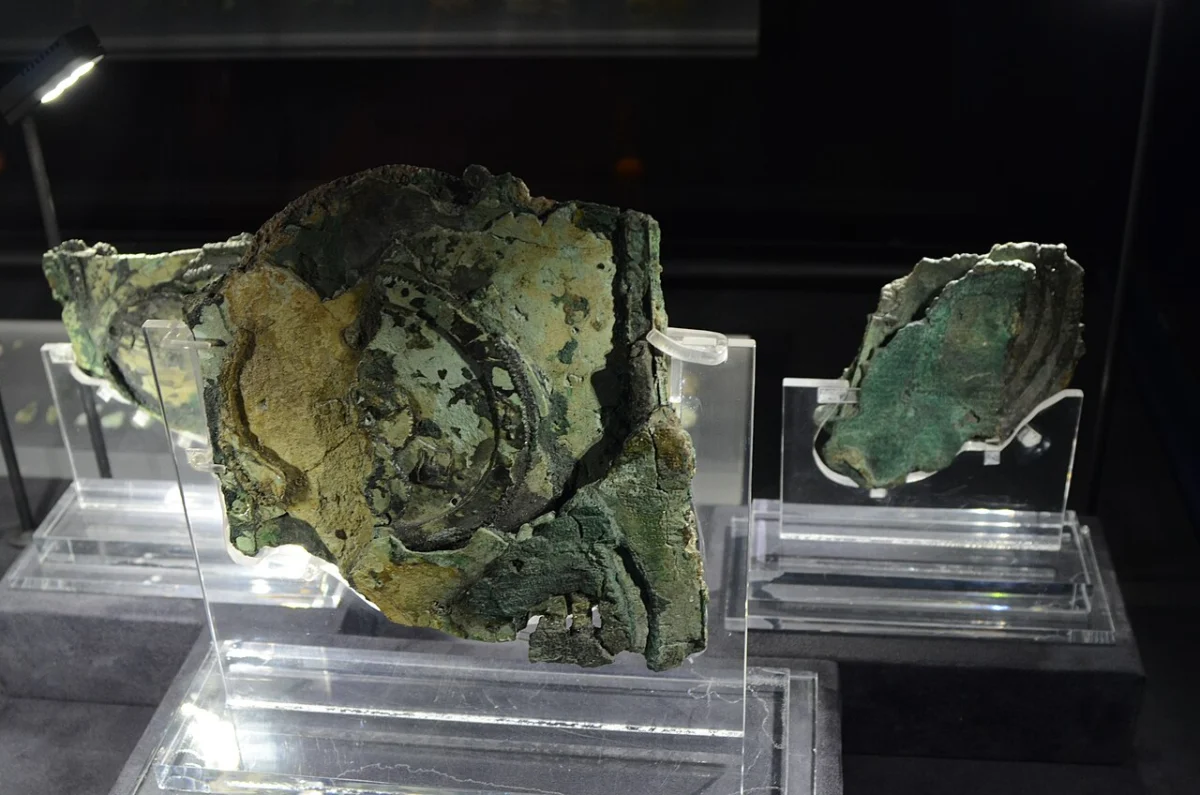
A lump of green bronze pulled from the sea held a way to predict events in the sky. Inside the crust were tiny wheels with teeth, each ready to turn another wheel.
Their maker had packed years of sky motion into a device small enough to carry. That is the strange heart of the Antikythera story.
This was no magical relic and no visitor from the future. It was skilled human work, built in the ancient Mediterranean.
With the Antikythera mechanism explained, its greatest secret becomes clear: people could make a model of time long before they could light a room with electricity.
A Shipwreck Hid the Machine
The mechanism came from a Roman-era wreck near the Greek island of Antikythera. Divers recovered it in 1901, but its use took far longer to spot. The damaged remains preserve parts of a complex sky device, rather than a complete machine ready to use.
Sponge divers found the wreck in 1900. Salvage followed, bringing up art and other goods from a ship that had crossed a busy trading world. The mechanism belonged to that cargo, though its owner and final destination remain unknown.
The sea did not save it neatly. Wood disappeared, metal corroded, and the machine broke into pieces. What lasts looks less like a calculator than something a cook might scrape from an old pan, if that pan had a degree in astronomy.
Scholars place the device in the Hellenistic world, around the second or first century BCE. Dates proposed for the start of its sky cycles do not by themselves give the year it was built. A calendar can begin counting long before the day someone makes it.
This distinction matters when a headline offers a single dramatic date. Scholars weigh inscriptions, the wreck, and mechanical evidence together. Each gives a clue; none provides a signed receipt from the workshop.
Picture the task as sorting a ruined book whose pages have fused. You must first see what remains, then decide what the missing pages could have said. Guess too soon, and your model may tell more about you than the old maker.
How Turning a Handle Moved the Sky
The device translated motion through linked bronze gears. Varied tooth counts made its hands move at varied rates, allowing one input to model several cycles. It functioned as an analog calculator: its moving parts stood for cycles in the sky instead of storing instructions like a modern computer.
To understand an ancient Greek computer, start with two wheels. A small wheel makes more turns than a large wheel when their teeth engage. Add more pairs, and you can create a ratio that matches a long cycle in the sky.
The cleverness lies in choosing those ratios. One hand could advance a date while other parts showed related sky facts. The machine turned patterns learned through years of watching the heavens into something a viewer could inspect on a dial.
Thirty surviving bronze gears give scholars direct evidence of this method. Yet many parts are gone, especially at the front. A working model must account for the fragments while fitting within a space the original case could have held.
The Moon created a special problem because its apparent speed changes. Research published in 2006 found a gear arrangement that could reproduce that change. The device did more than make everything spin at one steady pace.
Calling it a computer is useful if we keep the meaning clear. It calculated through the motion of its parts.
It could not download a chart, choose a new program, or answer an unrelated question. Its use was narrow, and its craft was striking.
Think of a music box. The shape of its parts controls what it does. Here, the result was a model of the sky rather than a tune.
The Back Dials Counted Years and Eclipses
Two spiral scales linked daily dates with long sky cycles. The upper date scale followed the nineteen-year Metonic cycle, while the lower scale tracked the 223 lunar months of the Saros cycle. Smaller displays added facts, including a cycle of Greek games and eclipse-time corrections.
A lunar month and a solar year do not fit neatly together. That makes a calendar based on both hard to manage. The Metonic cycle offers a close match between nineteen solar years and 235 lunar months.
On the upper back dial, those months ran along a spiral. Month names help place the machine within the calendar traditions of the Greek world. They hint at cultural links, though they do not prove who made it.
The lower dial supported eclipse prediction. Its Saros cycle marked a pattern after which similar eclipse conditions return. Tiny inscriptions marked predicted solar or lunar events and gave timing facts.
This did not mean every listed solar eclipse would be visible wherever the owner stood. The shadow of the Moon reaches only part of Earth. Predicting an event in a cycle and predicting the local view are distinct tasks.
An extra dial helped correct eclipse times across longer repetitions. Another followed a four-year schedule of athletic festivals. The machine thus connected cosmic rhythms with events that mattered to groups on the ground.
Imagine the practical appeal. A person could compare distant dates without waiting for those years to pass. The future appeared as a pointer on a scale, not as a promise that nature would obey every mark perfectly.
X-Rays Read What Eyes Could Not
Modern imaging revealed hidden teeth and faint writing inside the corroded fragments. These clues let scholars test models against physical evidence. A proposed planetary display published in 2021 explains many findings, but a plausible model is still a proposed design, not the recovered original mechanism.
Surface images catch letters that light from one angle may miss. X-ray computed tomography looks into layers of metal without taking the fragile piece apart. Together, these methods let scholars examine structures that were once sealed from view.
The inscriptions describe sky displays and name celestial bodies. They give the mechanism a voice, though much of that voice is broken. Reading a few letters well can be more useful than building a beautiful model based on a weak guess.
The 2021 UCL model proposed a way to show the Sun, Moon, and five planets then known to the Greeks. Planetary motion is difficult because a planet can seem to reverse direction against the stars when viewed from Earth.
The team worked from saved parts and inscribed cycle numbers. Their design showed how a compact gear system might create the display. The original front gearwork remains largely missing, so details need more testing.
That doubt is part of good Greek astronomy research. A model should explain the evidence and withstand attempts to disprove it. It should not win merely because it looks striking in a video.
There is pleasure in watching this process. New tools do not erase old skill; they help us see it. Each scan brings the craftsman closer without inventing a life story for someone whose name we do not know.
What the Device Reveals About Ancient Skill
The mechanism shows that ancient knowledge could take a highly precise mechanical form. It joins sky observations, mathematical cycles, metalworking, and clear display design. Its maker and exact use remain unclear, but the surviving piece challenges any simple story in which craft progress always moves forward.
Who paid for it? Who turned its handle?
Scholars have proposed settings such as teaching, elite display, and learned study. None has been proved as its sole use.
The machine might have meant varied things to varied viewers.
Its building needed more than one bright idea. Someone had to cut reliable teeth, position shafts, plan scales, and assemble a case. Even when we cannot name the workers, the piece records a chain of patient decisions.
A useful lesson follows from that chain. Knowledge lasts only when people can pass it on, afford to practice it, and keep examples intact.
Bronze can be melted down. Workshops can close.
A written account may never mention a tool that seemed normal to its author.
The lack of another equally complete device does not prove this one appeared from nowhere. It also does not give us permission to imagine vast hidden factories. The safest position leaves room for a broad craft tradition without claiming evidence we lack.
Look again at the corroded fragment. Its quiet beauty comes from scale: small teeth attempted to capture enormous spans of time. A damaged piece can still preserve a great act of thought, even when most of the hands that shaped it have vanished.
Frequently Asked Questions
These answers address the questions readers often bring to this topic. They separate what the surviving evidence shows from what scholars still debate, so you can follow the story without mistaking a useful theory, a modern model, or a well-known legend for a proven fact.
Could the Antikythera mechanism predict every eclipse?
It used repeating cycles to indicate possible solar and lunar eclipses and timing facts. A forecast solar eclipse was not necessarily visible at the location where the device was being used.
Was the mechanism made by Archimedes?
No surviving evidence identifies Archimedes as its maker. Scholars discuss links to Greek scientific traditions, but such links differ from evidence of a named inventor.
Why is it called an analog computer?
Its gears and hands stood for number links through motion. It calculated exact sky cycles rather than running software or performing general-use tasks.