The trees fell, but no giant hole waited beneath them. Across a remote stretch of Siberia, trunks lay in a broad pattern that showed something powerful had passed through the air above the forest.
The Tunguska explosion happened on June 30, 1908. Its effects were immense, yet the missing impact crater left a space where unusual theories could grow.
That space is smaller than it first appears. An object from space can release much of its energy before reaching the ground, producing a destructive blast without leaving the kind of scar we expect.
The event remains valuable not because every detail is settled, but because it links a strange historical scene with a hazard scientists still study today.
The Forest Recorded a Blast From Above
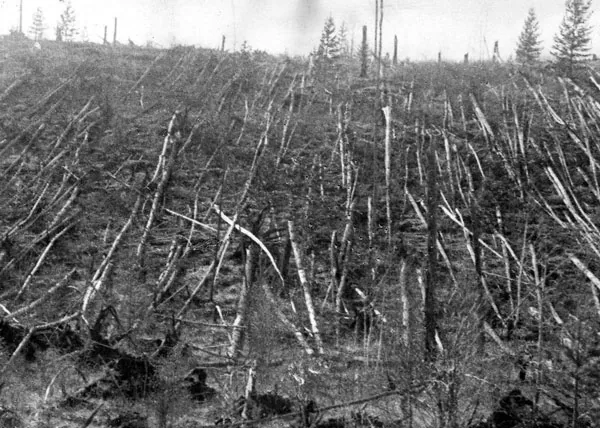
The 1908 blast flattened roughly two thousand square kilometers of Siberian forest. Witnesses described light and a powerful explosion, while the fallen trees recorded force from above. These effects and the missing large crater fit an atmospheric airburst, in which a space body breaks apart before direct impact.
The most famous photographs show trees lying like matchsticks. The scale is hard to grasp until you imagine a forest extending far beyond one frame.
An explosion in the air can send a pressure wave downward and outward. That wave can affect a wide area without a single solid object digging a deep hole at its center.
The fallen forest therefore became a physical record of the event. Its pattern mattered more than any one dramatic tree.
A Missing Crater Was Still Evidence
People often expect a space impact to leave a crater. That expectation fits some events, but it should not become a rule for all of them.
The atmosphere is part of the encounter. An incoming body meets air at high speed, and the stresses can become great enough to break it apart.
If much of the energy is released above the surface, the ground experiences the blast rather than a full direct impact. The result can be devastating without matching the image of a rock lodged in a hole.
The missing crater helped guide the explanation. It did not, by itself, require a cause outside ordinary physics.
An Airburst Converts Speed Into Destructive Energy
An incoming body carries great kinetic energy because of its speed. As denser air stresses it, fragmentation increases the surface exposed to the atmosphere and can release energy rapidly. The resulting heat and shock wave explain why an object need not remain intact to cause severe damage below.
An asteroid airburst involves conditions far different from a stone dropped from a roof. Its speed makes the encounter violent.
The air in front of it compresses and heats. Pressure builds around the body, and weaknesses in the material can open under that stress.
Once fragmentation begins, the pieces expose more surface to the air. Energy can then be transferred quickly rather than remaining in one intact body all the way to the ground.
The Useful Comparison Is a Process, Not a Bomb Count
Descriptions often compare Tunguska with nuclear weapons. Such comparisons can convey scale, but they do not mean the event used the same mechanism.
A meteor shock wave comes from the incoming body’s interaction with the atmosphere. The comparison should not be mistaken for evidence of a human or alien weapon.
It is also wise to avoid treating one energy estimate as perfectly exact. Researchers model a past event using limited observations and a landscape altered over time.
Different assumptions about size, material, and height can change the estimate. The uncertainty is part of reconstructing the physics, not a reason to abandon the leading explanation.
The First Investigators Arrived Long After the Event
The remote location delayed detailed scientific investigation. Leonid Kulik‘s expeditions in the 1920s examined the damaged forest and helped establish the event’s physical setting. The delay meant researchers had to work with surviving effects and memories, rather than fresh samples and instruments recording the blast as it happened.
In 1908 Siberia, a distant forest was not easy to reach. Travel, supplies, and local conditions shaped what an expedition could do.
Leonid Kulik had to investigate a landscape years after its most dramatic moment. Nature had already begun changing the evidence.
Trees decay, new growth appears, and small particles can move through soil and water. A site is not preserved simply because it lies far from a city.
Witnesses and Landscape Answer Different Questions
A witness can describe a light, a sound, or the force of a blast. Memory and the conditions of observation limit the precision of that account.
A fallen tree can show direction and physical effect. It cannot say what a person saw in the sky or feared at the time.
The strongest reconstruction brings different forms of evidence together. It does not ask one kind to provide answers it cannot supply.
That approach also gives local knowledge its proper place. People who lived in the region were part of the history and the investigation, not merely a backdrop for later scientific visitors.
Asteroid or Comet Remains a More Specific Question
The broad airburst explanation is stronger than knowledge of the object’s exact material. Asteroid and comet proposals address a more specific question about its composition and behavior. Uncertainty there doesn’t make all causes equally supported or erase the physical evidence favoring an atmospheric explosion from an incoming space body.
An icy body and a rocky body can behave differently when entering the atmosphere. Density, strength, and the way material breaks apart affect the result.
Those differences help explain why researchers have debated what kind of object produced Tunguska. A limited sample record makes the question harder.
But uncertainty about composition is not uncertainty about every aspect of the event. A broad explanation can be strong while a smaller detail remains open.
Do Not Make All Theories Equal
The lack of a neat fragment with a complete story attached has invited dramatic ideas. Some involve unusual machines, exotic physics, or visitors from space.
An idea’s dramatic force does not place it on the same footing as a model grounded in known airburst processes. Evidence has to do that work.
The right question is what each proposal explains and what independent support it has. A story that merely uses the word mystery does not answer the forest, timing, and blast pattern.
The ordinary mechanism is already remarkable. A natural object can change a huge landscape in moments without any need to borrow a science-fiction plot.
The Event Still Guides Planetary Defense
Tunguska demonstrates that an atmospheric breakup can still cause major regional damage. Planetary defense therefore studies smaller objects as well as potential global hazards. Detecting and modeling their paths and entry behavior helps prepare for risk, without treating every object in space as an imminent threat to people.
Planetary defense includes more than finding the largest objects. Size, orbit, composition, and likely entry behavior all affect risk.
Tunguska reminds us that the atmosphere is not a perfect shield. It can prevent a direct impact while still allowing energy to reach the ground in a harmful way.
The 2013 Chelyabinsk airburst offered a much more recent example of atmospheric effects. Its observations also showed the value of modern records for testing models.
A Remote Disaster Can Teach a Populated World
The 1908 event struck a sparsely populated region. Its physical scale invites a sobering question about what a similar blast could do over a city.
That comparison should support preparation, not panic. Hazard research works by improving knowledge of possibilities and likelihoods rather than treating every unknown object as an immediate threat.
The Tunguska explosion is most useful when it sharpens those questions. What can be detected, what can be modeled, and what should people do with a warning?
The old fallen forest still speaks to that work. Its missing crater is not the end of the explanation; it is one of the clues that makes the explanation possible.
Frequently Asked Questions
Tunguska is often presented as a mystery with no plausible cause because a crater was not found. The evidence supports a more focused discussion. These answers explain how an airburst differs from a direct impact, what remains uncertain, and why the event still matters to people studying hazards from space.
Why did Tunguska not leave a huge crater?
The leading explanation is that the incoming object released most of its energy in the atmosphere. A blast from above can flatten forest without producing a large direct-impact crater.
Was the object definitely a comet?
Its precise composition is debated. An atmospheric explosion from a space body is better established than a single confirmed description of the object’s material and size.
Could a similar event happen again?
Airbursts are a real class of natural event, though large damaging ones are uncommon. Modern observation and modeling aim to improve detection and preparedness rather than promise that every object will be seen in time.