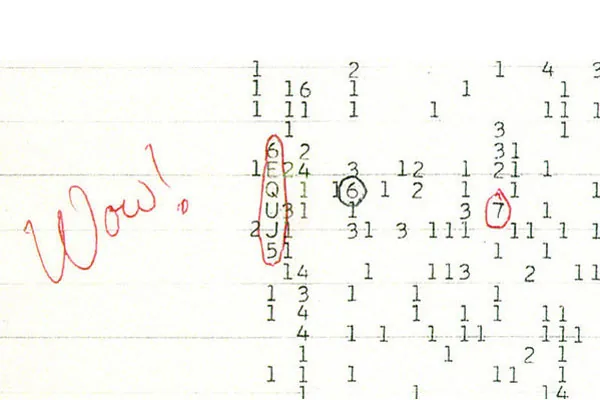
Six characters on a computer printout made a quiet night famous. The line read 6EQUJ5, and astronomer Jerry Ehman circled it before writing the word that gave the event its name.
The characters were not an alien greeting. They were a compact way to record how strong a radio signal appeared during a short pass through a telescope’s view.
Wow signal explained is a search for a careful answer to a thrilling question. What produced that brief rise and fall, and why has a convincing repeat been so hard to find?
The event belongs to real radio astronomy. Its fame belongs partly to what the evidence cannot yet tell us, which is exactly why a claim of contact would go too far.
What the Telescope Recorded in 1977
Big Ear recorded a strong narrowband signal on August 15, 1977, during a search for unusual radio emissions. It stood out enough to attract investigation, but the printout contained measurements rather than a decoded greeting. The observation didn’t identify its source or confirm that extraterrestrial intelligence produced it.
The Big Ear telescope was not a person holding a dish and turning toward a voice. Its design let the sky move through its view as Earth rotated.
That motion is important. A source in the right place would grow stronger, reach a peak, then weaken as the telescope’s sensitive region passed across it.
The famous printout captured a sequence like that. It gave researchers a pattern to examine rather than a recording of words to translate.
A Number Can Look Like a Message Without Being One
The system used digits and letters to represent signal strength. Higher values could be shown with letters after the available digits were used.
That makes 6EQUJ5 a measurement code. The sequence tells us about the recorded intensity, not what a sender might have wished to say.
Confusing those roles makes the story sound more solved than it is. A clear-looking string can feel like language even when it belongs to an instrument’s reporting method.
The real excitement is not that someone read a greeting. It is that a signal appeared with features worth investigating and then left a frustratingly small trail.
Why a Narrowband Signal Attracted Attention
A narrowband signal can interest SETI researchers because technology may produce concentrated radio emissions. The Wow observation also lay near a frequency associated with hydrogen. Those features justified follow-up, but neither one proves an intelligent sender without evidence excluding natural, human, and instrumental alternatives for the recorded signal.
The hydrogen frequency has a special place in astronomy. Hydrogen is common across the universe, and its radio emission offers a natural reference point for researchers.
A search for technology can therefore give extra attention to signals near that region. The choice is a strategy for looking, not a rule that aliens must follow.
Radio astronomy also works within a noisy world. Natural sources, human equipment, and the receiver itself can all affect what an instrument records.
Interesting Is the Start of a Test
SETI search methods try to sort unusual candidates from ordinary signals. A candidate’s shape, frequency, timing, and later behavior all matter.
One striking property does not settle the source. A signal can deserve follow-up without being a discovery of life.
That distinction protects the search from both excitement and dismissal. It allows researchers to take the event seriously while keeping their claim as small as the evidence requires.
The Wow signal remained interesting because several features fit what observers wanted to notice. The next task was to find out whether those features belonged to a repeatable source.
The Seventy-Two Seconds Were Not a Known Message Length
The recorded duration matched the time a sky position could pass through Big Ear’s observing beam. It does not prove that a transmitter turned on for seventy-two seconds. The telescope’s view shaped what it could record, leaving the actual source duration unknown and making follow-up observations essential to the interpretation.
The number seventy-two gives the story a crisp shape. It can sound like a sender deliberately chose a short window to announce its presence.
The instrument offers a less dramatic explanation for that specific length. The telescope could only observe the relevant place during its pass through the beam.
A signal might have continued beyond that window without appearing in the same record. It might also have stopped, but this observation alone cannot decide which happened.
The Beam Left an Important Puzzle
Big Ear used two observing beams that should have sampled a continuing source at different times. The candidate was recorded in one, not clearly in both.
That detail complicates a simple picture of a steady radio source waiting at one spot. It is one reason the event has resisted an easy account.
The direction was also not fixed to one perfectly known point. Uncertainty in the observing arrangement limited where later searches could focus.
These are not flaws that make the event imaginary. They are the boundaries of the record, and they determine what a careful explanation must address.
Why Follow-Up Matters More Than a Famous Printout
A repeat could help locate the source and compare its frequency, strength, and timing. No generally accepted repeat has identified the original event. Explanations therefore need to address the whole observing record, including beam behavior, rather than promote one appealing feature into a complete account of the source.
A second event would not automatically prove alien technology. It would give scientists more than one brief record to work with.
They could ask whether the signal came from the same direction, used the same frequency range, or followed a pattern tied to an identifiable source.
A single printout cannot supply those comparisons. Its strength is also its limit: it records one unusual episode clearly enough to remain interesting.
A Good Explanation Must Fit the Whole Record
Alien signal claims often focus on the narrow frequency range and leave the observing geometry behind. Other proposals may explain a possible radio source without showing why the beams behaved as they did.
A useful explanation should address timing, direction, strength, and the lack of a convincing repeat. It should also state which parts remain uncertain.
That standard is harder than finding one story that sounds possible. The universe and human radio activity contain many possible sources.
The question is not whether we can invent an account. It is whether evidence selects that account over its rivals.
An Unsolved Signal Is Not the Same as Confirmed Contact
The Wow signal remains a notable candidate in the history of searching for extraterrestrial intelligence. It isn’t confirmed contact, and its unexplained status shouldn’t be treated as proof that an extraordinary explanation is correct. The honest result is a limited real observation whose cause still requires stronger evidence to identify.
There is an understandable wish to turn an empty space in knowledge into something vivid. A lonely signal from another civilization is a more moving image than an unresolved technical puzzle.
But wonder does not need certainty to remain valuable. The event shows that people built an instrument, searched carefully, and noticed something that deserved a closer look.
It also shows how science handles a limit. Researchers can preserve a question without announcing an answer they have not earned.
The Search Continues Beyond One Famous Event
Modern searches use new instruments and methods, while still facing the need to separate a strong candidate from a confirmed finding. More data can sharpen that work.
The old printout therefore belongs within a wider effort. It is not the whole case for life elsewhere, nor a reason to stop looking.
Wow signal explained ends with a distinction that is easy to say and hard to keep. A signal was observed; an intelligent sender was not established.
The space between those statements is where the research belongs. It is also where the story keeps its quiet, lasting pull.
Frequently Asked Questions
The event is often described as a message, but the famous record contains measurements of signal strength rather than readable language. These answers separate what the telescope observed from what stories added, explaining the character sequence, the short window, and the distinction between an intriguing candidate and verified extraterrestrial contact.
What does 6EQUJ5 mean?
It is a code for the strength recorded across successive samples. The letters and digit are not a translated alien sentence or a known message addressed to Earth.
Was the signal sent for exactly seventy-two seconds?
That was the observation window as the relevant sky position crossed the telescope’s beam. The record does not establish the full duration of the source itself.
Has the Wow signal proved that aliens exist?
No, its source has not been confirmed as extraterrestrial technology. A strong identification would need evidence that distinguishes that explanation from natural, human, and instrumental alternatives.