The hottest planet is not the one closest to the Sun. Mercury sits nearer, but Venus has a surface hot enough to melt lead.
That contrast makes a simple distance rule fail. The air above a planet can matter as much as where the planet travels.
Why Venus is so hot is therefore a story about energy entering and leaving a world. Its thick atmosphere makes escape difficult for heat that the surface releases.
The result is not an ordinary warm afternoon stretched a little further. It is a planet with extreme heat and pressure, bright clouds overhead, and a surface that has challenged every machine sent to stand on it.
The Atmosphere Changes the Energy Balance
Venus’s dense carbon-dioxide atmosphere absorbs and emits infrared radiation, producing an extreme greenhouse effect. Its surface must become very hot for the system to release energy at the rate it receives it. Distance from the Sun alone cannot explain that balance, because the atmosphere changes the path of escaping heat.
The Venus atmosphere is not a thin veil above the rock. Its great mass creates conditions very different from the air at Earth’s surface.
Sunlight supplies energy, but the surface also has to lose energy. Much of that loss occurs through infrared radiation, the kind associated with heat.
Carbon dioxide affects the path that radiation takes. Energy can be absorbed and emitted within the atmosphere rather than escaping directly from the surface.
Trapped Heat Is a Useful Image With Limits
The phrase heat trap helps explain the outcome, but it can sound as if energy enters and never leaves. Venus still radiates energy into space.
The important question is the temperature required for the whole system to balance incoming and outgoing energy. A strong greenhouse effect changes that temperature.
A blanket offers a familiar comparison, though a planetary atmosphere is more complex. The point is not that carbon dioxide creates energy from nothing.
It changes how energy moves and escapes. That difference is enough to make a world near Earth’s size feel like a place from another kind of universe.
The Surface Combines Heat With Crushing Pressure
Venus’s average surface temperature is roughly 465 degrees Celsius, or about 870 degrees Fahrenheit. Surface pressure is around ninety times Earth’s sea-level pressure. Those conditions affect materials, electronics, and the design of landers, making the planet difficult to explore from the ground even before other environmental challenges are considered.
Surface pressure gives the heat a second dimension. A machine must withstand a dense atmosphere as well as an extreme temperature.
The pressure is often compared with being deep underwater on Earth. The comparison conveys force, not a claim that Venus has a present-day ocean covering its surface.
Heat also affects the way components work. Electronics and seals cannot simply be taken from an ordinary terrestrial environment and expected to perform indefinitely.
The Challenge Is Sustained Operation
A lander can survive arrival and still fail after its systems grow too hot. Insulation can slow heat transfer without making the external temperature disappear.
Power, communications, and the condition of instruments all belong to the problem. A successful measurement may require many systems to function together during a limited window.
That makes a short surface record a real achievement. Its duration should be judged against the environment, not mocked because a machine lasted longer somewhere cooler.
Planetary exploration is shaped by conditions. Venus is one of the clearest reminders that reaching a world and working on it are separate engineering tasks.
Bright Clouds Do Not Mean a Cool Surface
Venus’s clouds reflect much sunlight, while the atmosphere below produces strong greenhouse warming. Incoming visible light and outgoing infrared radiation follow different paths, so a bright cloud cover can coexist with a hot surface. Understanding the planet requires the whole energy balance, not treating reflectivity as a complete temperature measurement.
From a distance, Venus can look calm and luminous. The cloud-covered face hides the rock below rather than showing its temperature directly.
The clouds include sulfuric acid droplets. Their chemistry is important, but it should not replace the main explanation of the dense greenhouse atmosphere.
A bright world is not automatically a cold one. Reflection tells us something about sunlight at the top of the system, while surface conditions depend on the system as a whole.
Looking Through the Cover Takes Other Tools
Visible-light views cannot map most of the surface through the clouds. Radar has therefore been important in revealing features below them.
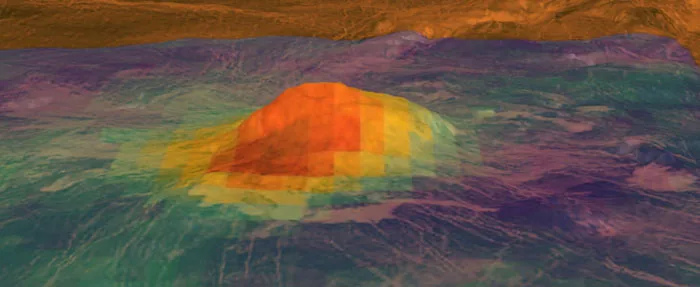
A radar map may use colors chosen to show data clearly. Those colors should not be mistaken for the appearance a person would see by standing beside the feature.
That distinction matters in image captions and alt text. A false-color view can be scientifically useful without being a natural-color photograph.
The cloud cover is thus both a striking visual feature and an observational barrier. It changes what a telescope or spacecraft can learn with a particular instrument.
The Ancient Water Story Remains Under Study
Researchers investigate whether Venus once had more favorable conditions and how it lost water. Climate models explore possible histories, including runaway greenhouse processes, but the planet’s early environment is not fully settled. It is therefore too strong to describe an ancient Earth-like ocean and its disappearance as an established sequence.
The runaway greenhouse effect concerns a feedback in which warming and water vapor can reinforce one another under suitable conditions. It offers a way to study how a world might move toward extreme heat.
Its role in a specific planetary history still requires evidence and modeling. Different assumptions about early water, clouds, rotation, and solar energy can change the result.
Venus’s present dryness and atmosphere are important clues. They do not provide a complete movie of the planet’s first billion years.
A Model Is a Test of a Possible Past
Planetary climate research uses models because the past cannot be observed directly. A model can ask whether certain starting conditions lead toward the world we see now.
Agreement with some present features makes a scenario useful. It does not automatically eliminate all other possible routes.
The stronger account states what is measured today and what is inferred about yesterday. That keeps an exciting ancient-ocean story from becoming more certain than the data.
The open questions are a reason to explore Venus further. They concern how planets change, not merely whether one dramatic reconstruction makes a pleasing illustration.
Venus Helps Us Understand Planets Without Becoming Earth’s Forecast
Venus offers a comparison for atmospheric physics and planetary change, especially because its size resembles Earth’s. The worlds also differ in water, orbit, and history. Studying Venus doesn’t establish that human climate change will reproduce every Venusian condition, but it helps clarify how air and energy shape a planet’s surface.
Venera landers gave researchers direct surface information under conditions no observer on Earth could create simply by looking through a telescope. Their records helped make the planet’s extremes concrete.
Other spacecraft and future investigations add different kinds of evidence. Each instrument can address a part of the system that another method leaves uncertain.
That is why Venus deserves more than the nickname Earth’s evil twin. A twin image highlights size while hiding the many ways the worlds diverged.
The Hottest World Asks a Clear Question
Why Venus is so hot has a strong central answer: its dense greenhouse atmosphere changes how heat escapes. The deeper history of how that system developed still invites research.
Both statements can be true. We can explain the present mechanism while continuing to debate the planet’s early water and climate.
That combination makes Venus a useful scientific story. A bright dot in the evening sky contains a lesson about the difference between appearance and conditions.
It also shows why a planet’s location is only the beginning. To understand its surface, we have to follow energy through the air above it and ask what kind of balance the whole world can reach.
Frequently Asked Questions
Familiar comparisons can hide the difference between measurements and a reconstructed past. These questions explain why Mercury isn’t hotter, how reflective clouds coexist with greenhouse warming, and why an ancient ocean remains under study. The current heating mechanism is well supported even while the planet’s earlier climate history stays uncertain.
Why is Venus hotter than Mercury?
Venus has a dense atmosphere with an extreme greenhouse effect. Mercury’s much thinner atmospheric environment does not retain heat in the same way, despite its closer orbit.
Do Venus’s clouds cool the planet?
They reflect a large share of incoming sunlight, but the full atmospheric system still produces extreme surface heat. Reflection at the top and greenhouse warming below can occur together.
Did Venus definitely once have oceans like Earth’s?
Its early water and climate history remain under investigation. Models explore possible oceans and their loss, but no single complete history is established as a direct observed fact.