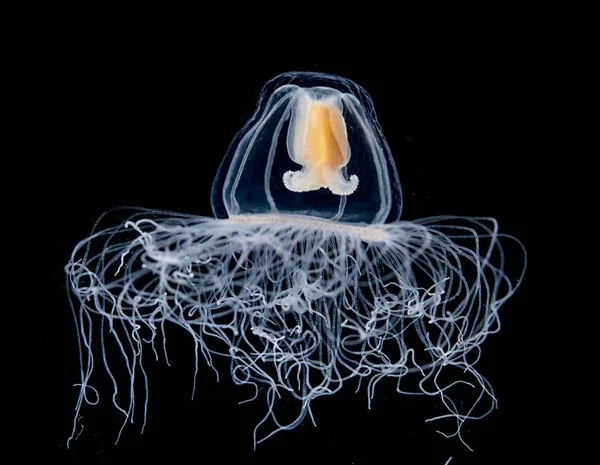
A tiny jellyfish can move backward through its own development. Instead of following only the familiar path from young to adult, it can return to an earlier form and begin another round of growth.
That ability gave Turritopsis dohrnii a name too large to ignore: the immortal jellyfish. The name captures a real biological process while inviting a much bigger claim than the evidence requires.
The immortal jellyfish life cycle is not a story about a creature that cannot be eaten, injured, or killed. It is a story about cells and development responding in an unusual way.
The difference matters. A small animal becomes more remarkable, not less, when we understand the actual process rather than asking it to fulfill a fantasy of endless life.
The Adult Can Return to an Earlier Stage
Turritopsis dohrnii can reverse from its free-swimming adult form toward a polyp stage under certain conditions. This developmental change has been observed in research and is the basis of its famous nickname. It isn’t a return to one single cell, and doesn’t mean every individual survives every reversal in nature.
The medusa stage is the form most people picture when they hear jellyfish. A small bell moves through the water with tentacles below it.
The polyp stage looks and lives differently. It is attached rather than freely drifting in the same way, and it belongs to the animal’s developmental cycle.
Returning to that stage changes the route through life. It is not simply making an old bell look younger while leaving everything else unchanged.
A Life Cycle Can Have More Than One Direction
Many animals follow a developmental path that does not normally reverse. The jellyfish challenges that expectation in a specific way.
A reversal involves coordinated changes in the body. Cells and tissues must become part of a different structure, not merely repair a small wound.
The distinction makes the process more interesting than a loose promise of anti-aging. It involves the way an organism can reorganize development.
Calling it a reset can help a reader begin, but the animal is not a phone restoring one saved file. Biology must carry out the change through living material.
Cell Reprogramming Changes What Tissue Can Become
Reversal involves coordinated changes in cellular function and tissue organization. Reprogramming is a useful broad description, but detailed pathways remain under study. Cells don’t simply become unlimited: they must contribute to a viable earlier form, making the process a system of developmental changes rather than one isolated immortality switch.
A specialized cell normally does a particular job. Its identity depends on patterns of activity that help it behave as part of a tissue.
Changing those patterns can alter what the cell contributes to the body. In the jellyfish, such changes belong to a larger developmental response.
Researchers study genes and cellular processes to understand how that response is organized. The work is more detailed than searching for one immortality switch.
The Body Has to Work as a System
A successful reversal cannot depend only on one isolated cell changing its role. The organism needs a coordinated route toward a viable earlier form.
That route includes the relationship between tissues, signals, and the conditions in which the animal is living. Biology works through those connections.
A gene associated with a process may be important without acting alone. Comparing genomes can identify promising differences, while further work is needed to explain what they do.
This is why a list of genes does not equal a complete mechanism. It offers places to investigate and questions to test.
Biological Immortality Has a Narrower Meaning Than the Name
Biological immortality describes the possibility of avoiding a usual one-way aging pattern through repeated life-cycle reversal. It does not mean an individual is invulnerable or has been observed living forever. Predation, disease, environmental stress, and failed development can still end the animal’s life, especially outside controlled laboratory conditions.
A jellyfish in the sea faces an ordinary food web. Another animal can eat it without waiting for a philosophical argument about aging.
Its small size and delicate body do not become armor because its development can reverse. Survival still depends on the environment and the success of each stage.
The word immortal therefore needs a careful explanation whenever it appears. Without one, a real process becomes a claim about a life with no possible ending.
An Endless Possibility Is Not an Observed Endless Life
A cycle that can repeat does not prove that one organism has already repeated it for an unlimited time. No experiment can watch a literal eternity.
Researchers can observe reversals, compare conditions, and study the mechanisms. Those results support the remarkable ability without establishing an impossible complete record of forever.
The distinction is not a technical trick. It is the difference between a tested process and a sweeping claim that cannot be observed in full.
The animal’s biology remains unusual when the claim is narrowed. It does not need to become invincible to deserve close attention.
The Discovery Required People to Notice an Unexpected Change
Laboratory observers recognized that an adult jellyfish could return toward an earlier stage, changing their view of its life cycle. The discovery shows why unexpected behavior deserves careful follow-up. Recording and testing the change turned surprise into evidence, while controlled conditions still differ from the risks encountered in open water.
An experiment can contain more than the result someone set out to find. Living organisms may change in ways that challenge the original plan.
The useful response is to notice, document, and test the change. An unusual observation becomes science through that follow-up work.
Jellyfish aging research therefore belongs to a history of attention as well as a history of extraordinary traits. Someone had to recognize that the change was not merely a mistake in the setup.
Controlled Conditions Help Define the Claim
A laboratory lets researchers observe a sequence that would be hard to follow in open water. They can compare conditions and look closely at stages of the reversal.
The same control limits how directly the result can describe a wild animal’s whole life. A culture does not contain every predator, current, or environmental change.
Both points matter. The experiment can establish an ability while leaving questions about how often it succeeds in nature.
A good account preserves that distinction instead of treating the laboratory as either perfect proof of wild immortality or a setting with no relevance at all.
What the Jellyfish Can Teach Without Promising Human Youth
The species provides a model for studying development, cellular identity, and biological responses to stress. Those insights may inform broader research, but they aren’t a method for reversing human aging. Differences between organisms and the demands of safe application make any human use a scientific question requiring evidence and testing.
Humans are not jellyfish with larger bodies. Our tissues, development, and ways of maintaining a body differ in important respects.
A result in one species can still be valuable. It may reveal a principle, a pathway, or a question that researchers would not otherwise have asked.
That value does not depend on a promise that people will soon repeat the same life cycle. A model can deepen knowledge without turning into a practical intervention.
The Real Wonder Fits in a Small Body
The immortal jellyfish life cycle changes a familiar assumption about how development moves. It shows that an adult state can be less final in some organisms than we expect.
The process is delicate, conditional, and open to study. Those qualities make it a scientific story rather than a magical escape from all limits.
Watch the sequence carefully and the nickname becomes easier to use responsibly. The animal can reverse a stage; it cannot step outside the risks of being alive.
That is enough to keep the story extraordinary. A small bell in the water holds a question about identity and change that no promise of eternal youth can explain better.
Frequently Asked Questions
The nickname often obscures the distinction between developmental reversal and invulnerability. These answers describe the actual stages involved, explain why a single-cell claim is misleading, and keep possible scientific value separate from untested promises about people. The result still inspires awe when immortal has a precise meaning.
Does the jellyfish become a single cell again?
No, the documented reversal leads toward an earlier polyp form. Describing it as a return to one single cell misrepresents the developmental process.
Can an immortal jellyfish still die?
Yes, predation, illness, environmental conditions, and unsuccessful development can end its life. Its reversal ability does not make the body immune to ordinary threats.
Does this prove humans can reverse aging?
No, the species offers a research model, not a ready-made human treatment. Applying any insight to people would require separate evidence about effectiveness, safety, and biological differences.