A shark may have begun its life before the United States became a country. That possibility comes not from a legend told around a harbor, but from research on a strange piece of tissue inside its eyes.
Greenland shark lifespan estimates stretch our sense of an animal’s life. They also come with uncertainty that often disappears when a headline assigns one shark an exact birthday.
The species moves through cold water on a scale of time far beyond our daily experience. Its age makes the animal remarkable, while its slow life history may also make it vulnerable.
The story is strongest when we keep both ideas together. A long life is a scientific discovery to investigate, not a guarantee that an animal is safe from human pressure.
The Eye Holds an Early Record of Life
Researchers studied material in eye lenses that forms and changes little afterward. Radiocarbon analysis of that tissue helped estimate age in a 2016 study. The approach supported centuries of life for sharks, but its results are ranges based on a model, not dates of birth recovered from a biological calendar.
Eye lens dating works because different tissues keep different records. Some parts of a body are renewed, while certain lens material remains closely linked to early development.
That distinction gave researchers a place to look when ordinary age methods were difficult to apply. A shark does not carry a readable tag from the day it was born.
Radiocarbon dating examines a form of carbon whose abundance changes through known processes. Interpreting the result still requires assumptions about the environment and the animal.
An Estimate Can Be Strong Without Being Exact
The famous study’s largest shark received an age estimate of about 392 years, with a wide uncertainty range. That is not the same as proving a precise age for the individual.
The uncertainty matters especially when a report turns the estimate into a dramatic historical comparison. It is fair to say the animal may have lived for centuries.
It is less careful to assign a year and describe events that definitely occurred during its childhood. The model does not supply that kind of biography.
The scientific result is already extraordinary. It does not need a false birthday to make its significance clear.
Slow Growth Helps Explain a Long Life History
Greenland sharks are associated with slow growth and cold marine environments. Their life history includes late maturity, which researchers estimate rather than observe across a centuries-long life. These traits help frame their longevity, but they do not identify one simple mechanism that explains every aspect of aging in the species.
Slow growth changes what size can mean. A large body may represent a long span of time rather than a few years of rapid development.
Arctic sharks also live within environments that shape their activity and energy use. Cold water is part of the setting, not a magic substance that grants unlimited life.
The relationship between growth, metabolism, and longevity requires research. An appealing explanation should not be mistaken for a complete account of the animal’s biology.
Maturity Has Consequences for a Population
If an animal takes a very long time to reach reproductive maturity, losses can be difficult to replace. A population may recover slowly even if some individuals can live for centuries.
That point is easy to miss. A long-lived species can sound naturally secure because it survives so much time.
Its vulnerability may lie in the opposite direction. Slow replacement means pressure today can affect the future for a long period.
Longevity therefore belongs in conservation planning as well as record books. The same traits that make the shark impressive can make careless losses especially costly.
The Shark Is More Than an Age Record
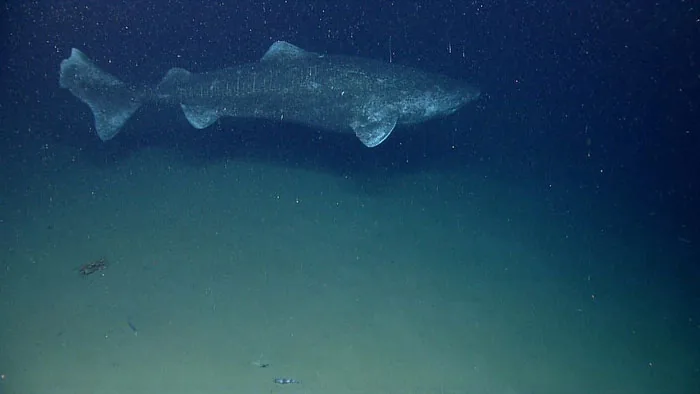
Greenland sharks are large predators and scavengers found beyond the island named in their common name. Depth and distance make their lives difficult to observe. Their feeding and movements belong to a marine ecosystem, so they are more than age records drifting through an otherwise empty cold sea.
A photograph often shows a heavy body moving through dark water. The animal can appear slow and distant from the fast image many people associate with sharks.
That appearance should not become its full description. Feeding, movement, and encounters with other organisms give the species a role in the sea.
Researchers cannot observe every part of that life easily. Deep water and wide ranges create practical limits on following individuals.
A Name Can Make a Range Seem Smaller
The word Greenland anchors the species to one place in a reader’s mind. The actual distribution reaches beyond a single island’s coast.
This is a useful reminder about common names. They can preserve a connection without serving as a complete map.
The animal’s life also involves more than the dramatic examples found in popular accounts. A strange stomach item does not necessarily show how every shark normally hunts or feeds.
A careful natural history asks what repeated observations support. It avoids making one unusual find the defining habit of a whole species.
Being Old Does Not Mean Being Immortal
Longevity doesn’t make the sharks unable to die. Capture, disease, injury, and environmental pressure can still end their lives. Studying their biology may illuminate aging, but an age estimate isn’t a ready-made human treatment or proof that a simple shark-derived secret could grant people a centuries-long lifespan.
Long-lived vertebrates offer valuable comparisons for biology. Their cells, tissues, and life histories may help researchers ask better questions about aging.
A comparison is not a ready-made treatment. Humans and sharks differ in ways that matter before a finding can be applied across species.
The excitement around a lifespan record can encourage promises that the study never made. A headline about the animal becoming a key to human immortality goes far beyond an age estimate.
Discovery and Application Are Different Tasks
Understanding a process in one animal requires careful work. Turning that understanding into a safe and useful human application would require another long chain of evidence.
There is no need to skip those stages to appreciate the shark. Its life is interesting without being sold as a cure for our fear of growing old.
The same restraint belongs in claims about why it lives so long. A plausible mechanism may be one factor among several.
Research progresses by narrowing those possibilities, not by finding one attractive word and treating it as the whole answer.
A Centuries-Long Life Deserves a Longer View
Slow growth and late maturity can make population losses hard to replace. Conservation therefore needs reliable monitoring and a timescale longer than one fishing season. A shark’s ability to live for centuries doesn’t protect a population if adults are removed faster than younger animals can replenish them.
A human decision can happen in minutes. Its consequences for a slow-growing shark population may last much longer.
That mismatch is part of the animal’s modern story. The age record invites wonder, while the population biology asks for patience and responsibility.
Shark conservation needs reliable data about captures and trends. A species cannot be protected well if its losses remain poorly understood.
The Historical Comparison Has a Better Use
Greenland shark lifespan can make familiar dates feel small. An estimated age measured in centuries reminds us that a living animal may connect periods we usually study in separate books.
That comparison should widen our attention, not create a fantasy biography. We do not know every place a shark traveled or every event it passed through.
What we know is enough to change the scale of the question. An old animal is not simply a curiosity; it is a survivor within a system that continues to change.
The remarkable eye-lens record points backward. Conservation asks whether future sharks will have the chance to leave a record just as long.
Frequently Asked Questions
Age estimates for this species are reported as records, and the difference matters. These answers explain what the research measured, why the range is wide, and why longevity should not be confused with immortality. They also connect the lifespan with the slow population recovery that makes conservation a serious concern.
Can Greenland sharks really live for several centuries?
Research supports exceptionally long lifespans, with the oldest studied individuals estimated in centuries. The age of a particular shark remains a range rather than a precisely known birthday.
How were the sharks’ ages estimated?
Researchers used radiocarbon analysis of early-formed eye-lens material. A model and environmental assumptions were needed to turn those measurements into age estimates.
Does a long lifespan protect them from extinction risks?
No, slow growth and late maturity can make losses difficult to replace. A population still needs protection from pressures that can remove adults faster than it can replenish them.