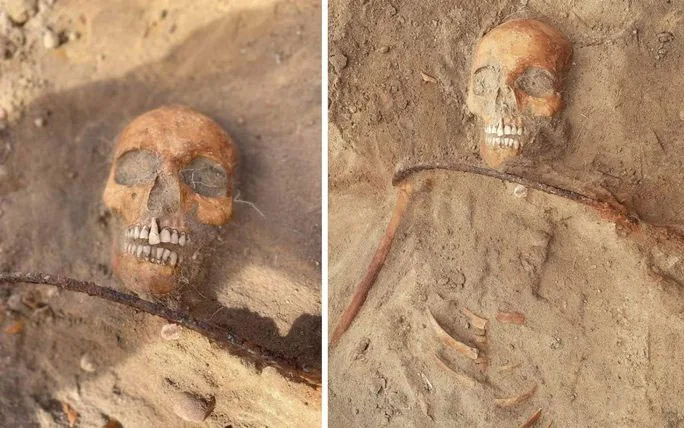
A sickle lies across a dead woman’s neck. Nearby, another grave holds a body placed in a way that makes the burial feel less like a farewell than a warning.
Such discoveries can inspire headlines about real vampires. The bones do not support that claim.
Vampire burials explained is a story about the living: their fears, customs, and decisions about people they believed might return after death. It is also a story about how much an archaeologist can infer from an unusual grave.
A restraint or a blade can suggest an act intended to prevent return. Its exact meaning still depends on the cemetery, date, local traditions, and evidence beyond the most unsettling object.
An Unusual Grave Is Evidence of a Human Choice
Restraints, blades, and unusual body positions can suggest attempts to prevent the dead returning. Researchers compare each grave with its cemetery and local history before assigning that meaning. The evidence concerns human beliefs and burial choices, not supernatural traits belonging to the person whose remains were treated.
Anti-vampire rituals varied across places and times. A device intended to restrict a body need not belong to the same belief as a blade placed near the throat.
The details matter. The position of an object, whether it was present at burial, and its relationship to the body help researchers assess what it may have meant.
A striking photograph shows only part of that information. It cannot replace the excavation record.
The Grave Is Not a Confession
A body does not explain why others treated it in a certain way. The people who arranged the burial may have acted from fear, custom, grief, or ideas we only partly know.
Calling the person a vampire can turn an accusation made by the living into a property of the dead. That is an important mistake to avoid.
The individual may have been an ordinary person whose community interpreted them through fear. The grave records that treatment, not the truth of the fear itself.
Archaeology becomes more humane when it keeps those roles clear. The person is not the monster promised by a headline.
Fear of Returning Dead Took Many Forms
Revenant beliefs describe fears that the dead might return or harm the living. They are broader than the vampire familiar from novels and films. Illness and unexpected death could influence burial responses, but the precise motive in one grave must be assessed through its own historical setting.
The elegant vampire in a dark coat belongs largely to later fiction. Earlier beliefs often pictured something less polished and more connected with the grave itself.
A revenant could be feared as a body that failed to remain at rest. The danger might involve illness, harm, or a disruption of the living community.
Those concerns arose in worlds where many forms of sickness had no clear explanation. People sought causes they could recognize and actions they could take.
A Belief Can Be Social as Well as Personal
An unusual death could affect a whole village’s sense of safety. Rumor and shared expectation might shape how a body was treated.
That does not mean every unusual burial resulted from panic. Customs can continue through ordinary practice as well as crisis.
The question for researchers is how a particular grave fits its setting. A cemetery with repeated patterns invites different interpretations from one isolated burial with missing context.
Revenant beliefs therefore need local study. One dramatic example should not become a rule for everyone who lived across centuries of European history.
Decomposition Could Look Like a Sign of Life
Natural decay can make a corpse look unlike what observers expect. Bloating and fluid movement helped shape some interpretations of returning dead. These processes can explain particular fears, but they don’t supply one universal origin for vampire traditions or establish the meaning of every unusual historical burial.
Decomposition myths often begin with a gap in ordinary knowledge. A body can change in ways that are disturbing even when nothing supernatural has happened.
Someone who expects a corpse to look dry and still may find a swollen or altered body alarming. Fear can then supply a meaning before the process is understood.
Later stories may preserve that meaning while losing the physical setting that first produced it. The tale becomes easier to repeat than the details of a grave.
Disease Explanations Need Caution Too
Modern accounts sometimes name a specific illness as the origin of vampire beliefs. Such claims can sound scientific while being much broader than the evidence supports.
A condition may resemble one feature of later fiction without explaining a whole historical tradition. A pale face or sensitivity to light is not proof of how a burial belief began.
The stronger approach examines particular records and settings. It avoids assigning diagnoses to long-dead people from a photograph or a dramatic description.
Science can explain many bodily processes. It should not be used as a confident label for every gap in a cultural history.
The Whole Cemetery Changes the Interpretation
A cemetery lets researchers compare graves and identify patterns in treatment, age, position, and objects. That context is stronger than one startling photograph. It may reveal shared practices or differences between groups, while leaving personal motives, names, and the precise fears behind individual burials beyond confident recovery.
A Polish cemetery makes an unusual grave more informative through comparison with other burials. The comparison can show whether a feature was common, rare, or tied to a particular group.
Deviant burials is a technical phrase used for burials that differ from an expected pattern. It should not be read as a judgment that the person was morally deviant.
The expected pattern itself has to be established. Without it, an observer may call something unusual simply because it looks unfamiliar today.
A Child’s Grave Requires Particular Care
Reports of restrained or face-down child burials can be deeply unsettling. The child’s treatment tells us something about decisions made by adults, not about a dangerous nature belonging to the child.
Interpretation should remain proportionate to the evidence. A restraint may suggest an intention to prevent return, but the precise fear and story may not survive.
Respect also affects description. The remains should not be turned into a prop for a frightening scene that the excavation cannot support.
The people in the cemetery once lived within families and communities. That fact should remain visible even when their burial practices attract modern curiosity.
The Real Mystery Is What Fear Made People Do
The graves record attempts to control uncertainty about death and illness. They reveal how fear can shape actions toward vulnerable people, without proving the supernatural danger that neighbors may have imagined. Their historical importance lies in what the living believed and did, not in confirming a monster.
Archaeological context makes the story less simple and more important. A blade across a neck asks us to consider who placed it there and why.
The answer may be incomplete. The act still shows that the living felt a need to control what they believed could happen after burial.
That need is part of a wider human history of fear. People can treat uncertainty as a reason to protect a community, while the person at the center of the fear loses a voice.
A Careful Name Can Restore That Voice
Vampire burials explained should begin with quotation marks in our thinking, even when a headline omits them. The label describes an interpretation of treatment, not a confirmed kind of human being.
That distinction does not make the finds less haunting. It changes the haunting from a monster story into a story about what neighbors believed and what those beliefs permitted.
The grave keeps a material record of a decision. Our responsibility is to read it without repeating the accusation as if it were a fact about the person.
The dead did not leave us a confession. They left evidence that fear, once made physical, can survive for centuries.
Frequently Asked Questions
Vampire burial is shorthand for an interpretation of grave treatment, not a confirmed type of person. These questions explain that distinction, the possible role of decay, and the need for context. They keep attention on human lives and practices rather than turning an unsettling object into supernatural proof.
Do these graves prove vampires existed?
No, they provide evidence of burial practices and possible beliefs about returning dead. They do not establish supernatural traits in the people who were buried.
Why would a sickle be placed near a neck?
Researchers may interpret its position as a measure intended to prevent a body from rising. That reading needs the grave’s full context and should not be assumed from the object alone.
Were all unusual burials anti-vampire burials?
No, burial differences can have several explanations. Researchers compare the wider cemetery and historical setting before assigning a specific belief to a grave.