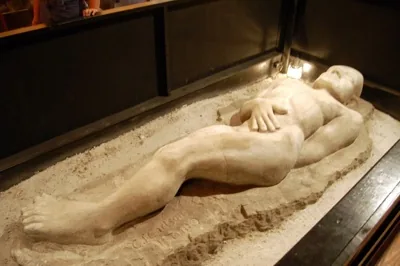
Two workers dug into a New York farm and uncovered what looked like a giant man made of stone. Before the object had a sound explanation, it had an audience willing to pay.
The Cardiff Giant hoax began its public life in 1869. Its success depended on more than a convincing sculpture; it needed a story that people wanted to test with their own eyes.
Some saw evidence of ancient giants. Others saw an old statue, a clever fraud, or simply a spectacle worth the price of admission.
The discovery was staged. What followed became a lesson in how a false object can acquire authority, earn money, and remain famous even after the claim that sold it has collapsed.
A Farm Discovery Gave the Figure a Plausible Entrance
The figure appeared beneath a farm near Cardiff, New York, in 1869. That staged setting made a newly carved object seem to come from the past. Soil and a discovery story gave the attraction credibility, but neither supplied reliable evidence for the giant’s claimed age or identity.
The 1869 discovery came with the right kind of setting for a wonder. Earth, labor, and surprise made the object appear to arrive from the past rather than a workshop.
That appearance mattered. A figure in an artist’s yard would invite questions about the maker, while a figure found beneath a farm could invite questions about an ancient world.
The same stone could tell a different story depending on how it entered public view. The hoax exploited that difference.
An Excavation Scene Can Be Manufactured
Fake archaeology does not require every part of a discovery to look false. Real soil and a real hole can surround a deliberately placed object.
The important question is whether the context is independently documented. An attractive account of discovery is not a substitute for a reliable record of where an object lay and how it reached the ground.
The Cardiff figure seemed to have a history because it had a location. That was only the beginning of the claim.
A responsible examination had to ask about the material and workmanship as well. The farm could not establish antiquity merely by providing the stage on which the statue was found.
George Hull Arranged a Giant That Could Sell a Belief
George Hull commissioned a gypsum figure and arranged its burial before discovery. The claim of a petrified giant entered existing debates about ancient giants, letting viewers supply part of its meaning. The fraud sold a physical object together with a story people were already prepared to consider.
A petrified giant gave the object a dramatic identity. The stone was not merely an artwork; it could appear to be a once-living body transformed over time.
That claim invited people to connect it with stories they already knew. The figure could become evidence for a larger world in which giants had walked the earth.
George Hull did not have to invent every belief around the object. He needed to create something that could fit into existing expectations.
The Audience Supplied Part of the Story
A viewer who wanted the giant to be real could find reasons to accept its appearance. Another viewer might pay to examine the claim without believing it.
Both kinds of attention could support the business. A ticket did not require a complete agreement about the object’s identity.
That is one reason a hoax can succeed before its details are settled. Curiosity itself has market value.
The figure was therefore sold through uncertainty as well as conviction. People wanted to see the thing everyone was discussing, and the unresolved argument made the opportunity feel urgent.
Money Could Arrive Before the Evidence Was Tested
The attraction earned money while its authenticity remained disputed. Paying visitors included believers and people curious enough to judge the object themselves. That distinction shows how uncertainty can support a spectacle: admission revenue depends on attention, not necessarily on every customer’s acceptance of the advertised historical claim.
American roadside spectacle had a receptive audience for strange objects. A giant offered scale, novelty, and a story that could be explained in a few memorable lines.
The business did not need to wait for a careful conclusion. Every day of debate could attract more visitors.
That creates a mismatch between the pace of inquiry and the pace of sales. Testing may be slow, while a claim can earn money as soon as people hear it.
Doubt Can Also Help Sell Tickets
A skeptical visitor may still want to stand beside the object. The visit becomes a way to participate in a public argument.
A promoter can benefit from that participation even if the visitor leaves unconvinced. Attention, rather than belief alone, is the valuable commodity.
This is a useful distinction in the history of fraud. A successful attraction does not prove that everyone who paid accepted the story.
Nor does a crowd establish authenticity. The crowd shows the power of the event and its marketing, while the object still has to answer questions about its age and origin.
Barnum’s Copy Made the Spectacle Stranger
Barnum promoted a rival copy after failing to acquire the original attraction. The competition shifted attention toward which giant was the genuine exhibit, even though neither was an ancient body. An original forgery can have a real commercial history without making its central claim about antiquity true.
P. T. Barnum understood that a popular wonder could generate demand beyond one exhibition. A copy offered another route to that audience.
The dispute then turned toward which object was the real attraction. That is a different question from whether either object was an actual ancient giant.
The distinction is almost comic. A fake could become authentic in one commercial sense because it was the first fake everyone had come to see.
Originality and Truth Are Different Properties
An original forged object can have a real date, maker, and history as a forgery. Those facts do not make its claimed ancient identity true.
A later copy can also become historically interesting. It records the reach of the original spectacle and the effort to profit from it.
The Cardiff story therefore contains several layers of authenticity. There is the real nineteenth-century statue, the false claim about its nature, and the later rival version.
A clear account keeps those layers apart. Otherwise, the word genuine can quietly shift meaning in the middle of a sentence and make the reader think the fraud has been confirmed as history.
Exposure Did Not End the Figure’s Cultural Life
Exposure ended the ancient-body claim but left a valuable nineteenth-century artifact. The statue survives as evidence of fraud, public belief, and showmanship. A museum can explain that documented history, changing the object’s role from supposed proof of ancient giants to a lesson about how manufactured wonders persuade.
A hoax can lose one identity and gain another. The giant stopped being credible as an ancient body while becoming a famous artifact of deception.
That second identity is worth preserving. It lets people examine how the object was presented and why its story found an audience.
A museum can show the figure with a clearer label than the original promoters used. The object then teaches through the failure of its old claim.
The Lesson Reaches Beyond a Stone Man
The Cardiff Giant hoax asks what makes an extraordinary object seem trustworthy. Size, a persuasive setting, public excitement, and an appealing story can all contribute before the strongest tests arrive.
Those forces have not vanished. A modern image or product can still gain attention faster than its claims can be checked.
The answer is not to reject everything unusual. It is to ask for evidence that connects the object to the identity being sold.
The stone man remains impressive in a different way. It shows how a made thing can gather a crowd, a belief, and a business around it, while the question that matters most waits beneath the spectacle: who made it, and when?
Frequently Asked Questions
The statue, its advertised identity, and Barnum’s rival copy are different parts of the story. These questions explain who arranged the hoax and why its exposure didn’t make the object historically worthless. A forged ancient claim can become genuine evidence of the later culture that produced it.
Was the Cardiff Giant a real ancient person?
No, it was a carved gypsum figure placed underground for a staged discovery. Its claimed identity as a petrified giant was false.
Who arranged the hoax?
George Hull commissioned the figure and arranged the plan that led to its discovery. The object’s public success then involved additional promoters and commercial interests.
Why is the statue still important after being exposed?
It is evidence of nineteenth-century belief, showmanship, and the business of public wonders. A false ancient identity does not erase its real history as a famous manufactured attraction.