A grid of strange symbols stayed unread for half a century. It passed through expert hands and private attempts, while its author used mystery and public fear as part of his own attention-seeking campaign.
The Zodiac 340 cipher was finally decoded in 2020. The result was a major cryptographic achievement, but it did not reveal a confirmed name for the killer.
That distinction is the story’s most important turn. Solving a message and solving a murder case are not the same task.
The cipher shows how a technical puzzle can become part of true crime. It also asks us to remember that the people harmed by the crimes matter more than the persona built around a page of symbols.
A Letter Turned Violence Into Public Performance
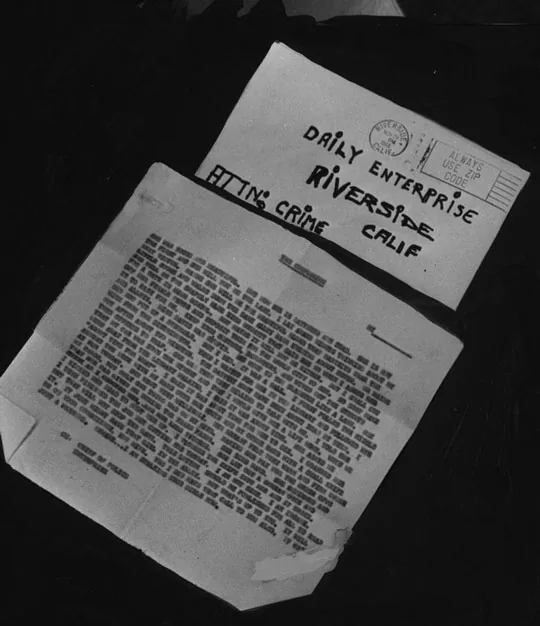
The 340-symbol message reached the press in 1969 as part of the Zodiac’s correspondence. Its unread form helped command attention, but secrecy didn’t guarantee an identity clue. The writer’s claims and presentation still required scrutiny, even after a successful decoding made the words available to investigators.
Zodiac Killer letters combined threats, claims, and attempts to control the story. The press became part of the setting in which the writer sought an audience.
A cipher added another barrier. Readers could see a text without being able to know what it said, making the writer seem to hold a secret over them.
The effect was powerful even before the content was understood. An unread page can draw years of attention precisely because it leaves room for people to hope it contains the missing answer.
The Persona Was Part of the Crime Story
The Zodiac name and symbols became a recognizable image. That image should not be treated as more important than the real attacks and their victims.
A writer’s claim about the number of crimes is not automatically a verified count. Investigators distinguish letters, evidence, and confirmed connections rather than accepting the persona’s statements at face value.
The same care applies to a decoded message. It tells us what the text says, not whether every claim inside it is true.
Reading the cipher accurately is the beginning of interpretation. It does not remove the need to assess the author’s purpose and credibility.
The Problem Involved More Than Replacing Symbols
The solution involved both replacing symbols and reading material in a rearranged order. Transposition complicated a simple left-to-right approach, while irregularities required explanation. A convincing result needed rules others could reproduce across the message, not merely a few recognizable words produced by one favored arrangement of the symbols.
A reader sees rows and expects to follow them from left to right. A transposition cipher disrupts that familiar order. A cipher can exploit that expectation by placing the meaningful order elsewhere.
The symbols may still correspond with letters, but the letters do not necessarily form words in the sequence a person first tries. Rearrangement becomes part of the task.
That adds many possibilities. A solver must choose not only what a sign means but how the signs should be traversed.
A Pattern Must Work Across the Message
A few readable words do not establish a solution. A method can produce fragments that look promising simply because so many possible arrangements have been tested.
The stronger result explains the larger text through rules others can follow. Special exceptions also need to be stated and assessed.
The 1969 cryptogram therefore demanded more than a clever guess at one line. Its solution had to make the page coherent as a system.
That requirement is what separates cryptographic work from a dramatic announcement based on a short accidental pattern. A convincing result remains convincing when someone else repeats the steps.
The 2020 Solution Was a Collaborative Achievement
David Oranchak, Sam Blake, and Jarl Van Eycke produced the accepted 2020 solution, which the FBI confirmed. Their work combined computation and analysis of the text’s arrangement. The breakthrough made the message readable without establishing the writer’s identity through the independent criminal evidence required to name a killer.
The cipher solution drew on different kinds of skill. Software could explore possibilities, while human reasoning helped decide which possibilities made sense.
That combination matters. A computer can generate an immense number of results without knowing which one is historically or linguistically credible.
A solver still needs standards for judging the output. The form of the text, the rules, and the completeness of the reading all enter that decision.
Long Effort Does Not Mean the Final Step Was Simple
A breakthrough can appear sudden when only the announcement is visible. Behind it may lie years of earlier attempts, tools, and failed approaches.
The long delay also reflects the nature of the task. An unusual arrangement can remain resistant even when the message is not especially long.
The team did not need to turn the writer into a genius beyond ordinary understanding. It needed to find a workable route through the actual text.
That is a more useful lesson than admiration for the killer. The achievement belongs to the people who made a difficult page readable, not to the harm that made the page famous.
The Message Did Not Deliver the Missing Name
The decoded words continued the writer’s self-focused claims and taunting rather than delivering a confirmed name. Reading a cipher and identifying a murderer are separate achievements. Investigators still needed evidence connecting a person with real acts, so the successful solution couldn’t substitute for that wider criminal case.
The public hope was understandable. A hidden text might contain a confession, a name, or a clue precise enough to end the case.
The actual reading did not fulfill that expectation. It made the writer’s words available without turning those words into the evidence needed for identification.
An FBI investigation involves more than the meaning of one page. Physical material, records, testimony, and the reliability of connections all matter.
Identification Is a Different Standard
True crime evidence must support a link between a person and a real act. A resemblance, a favored theory, or a self-referential line is not enough.
This is especially important when naming suspects. An interesting possibility can cause harm if it is presented as a solved identity without adequate support.
The cipher and the case should therefore be reported with separate conclusions. The text was decoded; the identity was not established by that achievement.
Keeping the two apart does not diminish the work. It gives readers a clear sense of what changed and what still requires evidence.
A Better True Crime Story Keeps the Victims in View
The puzzle’s fame can overshadow victims and families whose loss continued regardless of its solution. A responsible account credits the decoding while treating it as one part of the investigation. Technical interest doesn’t require admiring the killer or repeating his self-created persona as the story’s central achievement.
A grid is easier to discuss than a family’s loss. It offers a problem with rules, a potential result, and the satisfaction of progress.
The crimes do not fit that clean structure. Their consequences continued whether a line of symbols could be read or not.
That difference should shape the tone. Solvers can be credited for their work without making the person behind the violence the hero of an ingenious game.
The Breakthrough Has a Clear Place in History
The Zodiac 340 cipher now belongs to the history of a successful decoding. Its method shows the value of collaboration and careful tests.
The remaining case belongs to a different history of evidence and loss. A complete account keeps both visible rather than allowing the more satisfying ending to cover the unresolved one.
The page is no longer silent. That is a real achievement, and it deserves a precise description.
Precision is also how the story avoids another false promise. A readable message can close one question while leaving the most painful question still open.
Frequently Asked Questions
The breakthrough was reported, and some summaries blurred the distinction between decoding and identification. These answers explain which cipher was solved, who contributed to the result, and why the message didn’t name a confirmed killer. They keep a technical achievement in proportion to the criminal investigation and its unresolved questions.
Was the Zodiac 340 cipher solved?
Yes, an accepted solution was announced in 2020 and confirmed by the FBI. The result made the long-unread message available through a reproducible decoding method.
Did the solution reveal the killer’s identity?
No, it did not establish a confirmed personal identity. Identifying a killer requires independent criminal evidence beyond making one message readable.
Who solved the cipher?
David Oranchak, Sam Blake, and Jarl Van Eycke formed the team credited with the breakthrough. Their work combined computational tools with analysis of the text’s arrangement.