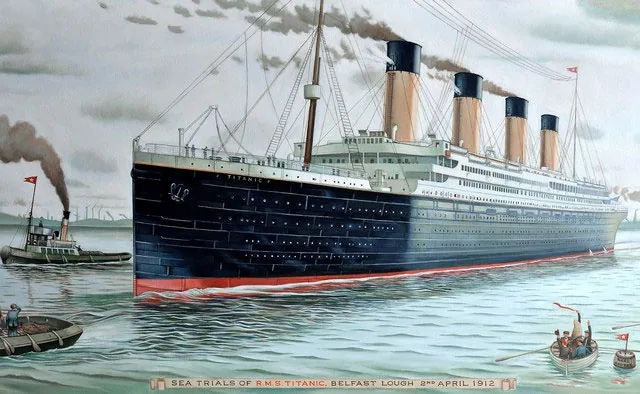
One of the most famous shapes in maritime history contained a small surprise. Titanic had four funnels, but only three carried smoke from its main boiler uptakes.
The fourth still had work to do. Calling it fake makes a good headline, yet that word can make readers miss the difference between boiler exhaust and other forms of ventilation.
The Titanic fourth funnel reveals how a ship could be both a machine and a public promise. Its outline told passengers what kind of vessel they were boarding, even before they saw a cabin.
That promise belonged to an age when speed, size, and luxury were sold through a skyline of masts and funnels. The design made sense within that world, even if its purpose needs a closer look today.
Three Funnels Handled the Main Boiler Smoke
Titanic’s first three funnels served the uptakes carrying exhaust from its boilers. The fourth was not connected to the main boilers that way. That difference explains why accounts call it a dummy funnel, although it also provided ventilation and was not simply an empty decorative object with no practical role.
A steamship needs a way to turn fuel into motion. On Titanic, boilers heated water to make steam, and the ship’s machinery used that steam to help drive its propellers.
Burning coal produced gases that had to leave the ship. Boiler uptakes guided that exhaust upward toward the working funnels.
The three main smoke funnels therefore belonged to the ship’s power system. They were part of a route connecting the boiler rooms with the open air.
A Ship Has More Than One Kind of Air to Move
Titanic ventilation involved other needs as well. Rooms and enclosed spaces could require fresh air or a way to carry warm, stale air away.
A structure that did not serve the main boilers could still fit into that wider system. That is why a narrow word like fake can lead to a broad and wrong conclusion.
The distinction is easy to understand in a modern building. A pipe serving a bathroom fan is not a chimney for a furnace, but it is not useless because it has a different job.
On a large liner, those different paths had to fit within an already crowded design.
Four Funnels Sold an Image of Power
Four-funnel liners had become strong symbols of speed, size, and prestige in the early twentieth century. A four-funnel outline helped Titanic appear balanced and impressive beside other celebrated ships. The design combined practical needs with visual appeal, showing that a liner’s public image could influence decisions about its exterior form.
Edwardian ocean liners competed for attention long before a passenger reached the gangway. Posters and photographs reduced a vast machine to a shape people could recognize at once.
Funnels were part of that shape. Tall stacks suggested powerful engines and a vessel built for serious ocean travel.
White Star Line also sold comfort. Its Olympic class ships were designed to make the voyage feel grand, not simply to win a race from one port to another.
Appearance Can Be Part of a Design Brief
A shipbuilder does not work only with pipes and forces. Owners may also want a vessel to look steady, elegant, or larger than a rival.
Those desires can affect the placement and shape of features. A balanced profile may matter to a business even when it does not make the engines stronger.
That is not unusual or necessarily dishonest. Modern cars, hotels, and aircraft also combine function with an image their buyers understand.
The important question is what a feature actually does. At Titanic’s stern end, the fourth funnel carried a visual role alongside its other uses, rather than duplicating the first three in every respect.
The Fourth Funnel Belonged to a Larger Interior System
The rear funnel served ventilation rather than the main boilers. Its ducts helped move air from enclosed parts of the ship, giving it a practical role alongside its contribution to the liner’s profile. Understanding that role requires looking below the decks, not only at photographs.
A photograph shows a smooth arrangement of decks and funnels. Inside, a large liner was a maze of compartments, stairs, stores, and service routes.
Air had to move through that maze. Heat, odors, and the needs of crowded spaces made ventilation part of the everyday work of the ship.
Steamship design therefore involved a hidden map as well as a visible one. A duct that looks small on a plan can have an important role for people living near it.
The Useful Detail Behind the Famous Silhouette
The fourth funnel is a good place to begin thinking about that hidden map. It reminds us that a feature’s purpose may not be clear from its outline alone.
Passengers did not need to understand every duct to enjoy a public room. Engineers and crew still had to make those rooms usable.
A luxurious interior depends on services that guests may never notice. Fresh air, heat, lighting, water, and waste all shape the experience without becoming the main attraction.
The rear funnel belonged to that relationship between comfort and machinery. Reducing it to a prop removes the practical world that sat beneath the ship’s elegance.
A Decorative Role Does Not Explain the Sinking
Titanic struck an iceberg and sank after water entered multiple forward compartments. The fourth funnel’s purpose does not explain that sequence. Claims that the ship sank because one stack was not a main smoke funnel confuse a design feature with the issues of damage, flooding, emergency response, and safety planning.
Titanic safety is a much wider topic than the number of visible funnels. The disaster involved how the hull was damaged and how water moved through the vessel afterward.
A striking detail can tempt readers to treat it as the missing key to everything. The fourth funnel does not support that leap.
Its design did not create the iceberg or determine every decision made that night. Nor would giving it a different smoke route automatically prevent flooding in the hull.
Keep Separate Questions Separate
Asking why the ship had four funnels is a good design question. Asking why so many lives were lost is a question about a disaster and its human response.
The subjects can share a setting without sharing one answer. Historical care means knowing when an appealing connection is not a demonstrated cause.
That care matters because Titanic has gathered many neat explanations over time. A single unusual feature is easier to remember than a chain of conditions and decisions.
The real story is harder, but it is also more useful. It asks how a large system behaves when several forms of protection fail to prevent or contain damage.
What the Funnel Teaches Us About Reading Old Technology
The fourth funnel shows that historical machines should be read through their systems, not only their appearance. A feature can serve several purposes, and a nickname can hide that complexity. Plans, technical records, and testimony help separate what a ship looked like from how its parts worked in daily use.
An old machine is often photographed at its most impressive angle. That view can make every feature seem more obvious than it really is.
A funnel looks like a chimney, so we expect all four to behave alike. The expectation is understandable, but the plans tell a more precise story.
The same habit affects other technology. A tower, vent, or housing may look decorative while protecting a service we cannot see.
The Detail Makes the Whole Ship More Human
The Titanic fourth funnel is worth remembering because it brings together several kinds of choice. Engineers needed routes for air, owners wanted an impressive vessel, and passengers read its shape as a promise.
Those choices did not happen in separate worlds. They met in one structure that people designed, built, maintained, and trusted.
The liner becomes more interesting when we allow that complexity. It was neither a perfect technical triumph nor a collection of empty tricks made to impress a crowd.
It was a working ship shaped by the demands and expectations of its age. One quiet funnel helps us see both the machine and the people who wanted it to look a certain way.
Frequently Asked Questions
The fourth funnel is often described with a word that sounds simpler than the evidence. These answers explain the difference between boiler exhaust, ventilation, and appearance. They also keep the feature in proportion, so an unusual part of the ship’s design is not mistaken for an explanation of the disaster.
Was Titanic’s fourth funnel completely fake?
It did not carry the main boiler exhaust in the same way as the first three funnels. It still served ventilation purposes and contributed to the ship’s balanced profile.
Did all four funnels produce boiler smoke?
The main boiler uptakes served the first three funnels. The rear funnel had a different arrangement and should not be treated as a fourth identical boiler chimney.
Did the fourth funnel cause Titanic to sink?
No evidence supports that simple claim. The sinking followed iceberg damage and flooding, while the scale of the loss involved additional questions of emergency response and safety.