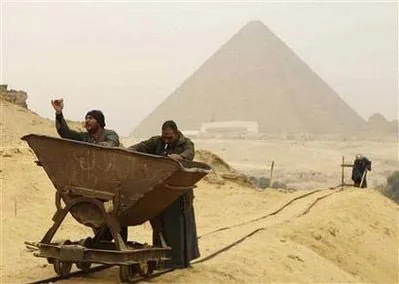
A pyramid required bread before it required another stone. The people hauling, shaping, and placing material needed meals, rest, tools, and a way to return to work the next day.
That ordinary demand changes the view from Giza. The monuments were not raised by a row of faceless figures existing only at the end of a rope.
Pyramid workers daily life emerges through settlements, ovens, animal remains, tools, and graves. Those traces do not answer every question about labor, but they reveal a far richer world than the familiar image of endless chains.
The strongest story begins beside the monument, where people cooked and lived. There, the scale of the project becomes a human problem as well as a feat of engineering.
A Work Force Needed a Settlement Behind It
Giza settlement remains reveal housing, food production, and administration supporting pyramid construction. Heit el-Ghurab is an important part of that evidence, not the home of every worker. Its layout shows how a monument depended on a wider community whose labor included much more than moving blocks of stone.
Giza workers town offers a different kind of view from the top of a pyramid. Walls and floors can show where people moved, slept, or carried out tasks.
A large building project draws on work beyond the construction area. Food arrives, tools wear out, materials need storage, and someone has to keep track of supplies.
That supporting labor matters. A stone cannot reach the next stage if the people needed to move it are hungry, absent, or waiting for equipment.
The Town Was Part of the Technology
It is easy to treat housing and meals as background. At Giza, they belonged to the system that made construction possible.
A work force needs organization across days and seasons. A settlement can reduce travel time, place supplies near demand, and bring several kinds of skill together.
The layout also leaves questions. A long building might have served one role at one time and another role later.
Researchers compare architecture with finds rather than assigning every room a purpose from its shape alone. That caution gives the settlement a history instead of turning it into one fixed diagram.
Bread and Beer Supported a Heavy Day
Food production mattered to the communities around the pyramids. Archaeological evidence includes places and material associated with bread-making, brewing, and handling animal products. Ancient Egyptian bread and beer supplied calories and formed part of everyday provisioning, though meals differed by context and the evidence cannot recover each person’s daily menu.
A loaf of bread can look too modest to belong in the story of a great monument. Its importance grows when thousands of tasks depend on people having the energy to perform them.
Grain had to be grown, moved, stored, prepared, and cooked. Each stage involved labor and a chance for supply to fail.
Beer also belonged to the food economy. Ancient brews were not identical to modern commercial drinks, and their role should not be reduced to the image of workers partying after a shift.
The Kitchen Leaves Its Own Record
Ovens, vessels, ash, and food scraps can tell researchers about repeated activity. They help show that a place served more than one impressive public event.
Animal bones may reveal which animals were handled and how they were processed. Their species, cuts, and distribution can all matter.
But a bone does not come with the eater’s name. Food remains can support a picture of supply while leaving differences between groups unresolved.
The right scale is therefore important. We can describe provisioning with confidence in some areas without claiming to know the contents of every worker’s bowl.
The Slave Picture Is Too Simple
Archaeology challenges the picture of pyramids built only by chained slaves. The labor system involved varied roles, skills, and obligations supported by organized provisioning. Rejecting that simple image doesn’t prove every worker had modern freedoms, since care and compulsory duties could coexist within an ancient state’s demands on its people.
Pyramid labor is often squeezed into two opposite pictures. One shows brutal masters forcing captives to move stone, while the other shows cheerful volunteers eager for the next haul.
Neither picture can stand in for the whole system. Ancient states organized work through relationships and duties that do not map neatly onto modern jobs.
Some tasks required long-trained skill. Others could draw on broader groups during particular periods, with different expectations of service.
A Duty Can Exist Without a Modern Wage Contract
A person might owe labor within a state system without signing the kind of employment agreement familiar today. That arrangement can be neither simple slavery nor modern free choice.
The evidence should guide the terms. A burial near the monuments, a record of a crew, and a well-fed group each tell us something specific.
None automatically answers every question about rights, control, or hardship. Material care and obligation can exist together.
The best account keeps those possibilities in view. It credits the workers’ skill without pretending that a huge royal project was effortless or equal for everyone involved.
Skill Was Hidden in Many Small Decisions
Pyramid construction required surveying, transport, stone working, and coordination alongside physical effort. Tools and work traces reveal some methods while leaving parts of the process uncertain. Precision came from people solving repeated problems across a large project, not from one unexplained act or a single universal building technique.
A block had to be selected and shaped for a purpose. Its weight and position affected what happened next.
Ropes, timber, ramps, and paths could be part of movement, but their exact use varied with the task and stage of work. A single method need not explain the whole project.
The people planning a day’s work had to think about sequence. A blocked path or a missing tool could slow several teams at once.
Organized Work Is a Human Achievement
Heit el-Ghurab reminds us that management leaves physical traces too. Stores, seals, rooms, and routes can help show how resources moved.
An administrator’s work may seem less heroic than hauling a huge stone. Without reliable supply, the haul might never begin.
The same is true of tool makers and food producers. A monument can gather their labor into one finished shape while hiding their names.
Looking for those people changes the meaning of the pyramid. Its scale becomes evidence of a network, not merely evidence of one ruler’s desire.
Graves Restore the People Behind the Project
Graves near Giza preserve evidence about health, status, and the communities associated with the work. Skeletons and burial settings can illuminate lives without becoming complete personal biographies. Their value lies in restoring people to the monument’s story while keeping conclusions proportional to what bones and context actually reveal.
A skeleton can preserve signs of a hard life. Bone responds to work, injury, disease, and age in ways that researchers can study with care.
Those signs are not a complete diary. A healed injury may show survival without revealing exactly how it occurred or who helped the person recover.
Workers cemeteries also reflect choices made by the living. Its location and form can say something about how a person was remembered.
The Monument Is Not the Only Legacy
Ancient Egyptian food supplies, work places, and burial evidence give the pyramid a second story. It is a story of bodies and routines, not just kings and dimensions.
That story does not reduce the achievement. It makes it more impressive by showing how many ordinary needs had to be met for the grand result to exist.
Pyramid workers daily life therefore belongs beside the engineering question. The people could build because a wider society organized the conditions that let them work.
A loaf, a tool, and a grave each carry part of that answer. Together they make the builders harder to dismiss as a line of anonymous figures beneath a whip.
Frequently Asked Questions
Accounts use labels too quickly when describing ancient workers. The archaeology offers a more varied picture of food, housing, skill, and obligation. These answers explain what the evidence changes about the slave myth, while avoiding the opposite mistake of treating a royal labor system as a workplace with modern rules.
Were the pyramids built entirely by slaves?
The evidence does not support that simple picture. Research points to organized labor involving different roles and obligations, with skilled people and substantial provisioning behind the construction.
What did pyramid workers eat?
Bread and beer were important staples, and animal remains show that other foods entered the supply system. Meals and access could vary, so no single menu should be assigned to every worker.
Does the workers town show where all builders lived?
No, Heit el-Ghurab is an important part of the settlement evidence at Giza. It does not represent every person, crew, or phase involved in building the pyramid complexes.