A wave of syrup tore through a city street. It pushed heavy objects aside, trapped people in a thick brown mass, and turned something familiar from a kitchen into a force that could kill.
The Great Molasses Flood struck Boston on January 15, 1919. A huge storage tank failed in the North End, releasing its contents into a neighborhood where people were going about an ordinary day.
The disaster killed twenty-one people and injured many more. Its strangeness can make the story sound almost comic, but the lives lost belong at the center of the account.
To understand it, we have to forget the slow drizzle from a spoon. A vast quantity of liquid under pressure behaves very differently when the wall holding it back suddenly gives way.
A Storage Tank Became a Neighborhood Hazard
The flood began when a molasses tank collapsed in Boston’s North End. It held roughly 2.3 million gallons, a quantity far beyond anything used in a household. Once the tank failed, gravity and the liquid’s stored height drove a fast release into nearby streets, buildings, and the harbor area.
Molasses had an industrial use as well as a place in food. It could serve as a raw material for alcohol production and other business needs.
That made a large storage tank part of an industrial system. Its contents arrived and waited there because companies needed a way to handle them in bulk.
The people living and working nearby had to share space with that system. A tank’s failure would not remain a problem contained within company property.
Size Changed the Risk
A leaking pantry jar is a mess. A tank holding millions of gallons is a structure with major loads pressing against its walls.
Its material, joints, foundations, and maintenance all matter. The question is not whether the liquid seems harmless in a cup.
The North End disaster shows why industrial safety begins with the whole setting. A structure may stand near homes and streets where the consequences of failure spread quickly.
Those consequences should be considered before an accident, when there is still time to change the design or address a warning.
Why a Thick Liquid Could Move So Fast
Molasses is viscous, meaning it resists flow, but a massive release can still move with destructive force. The tank’s height and volume created a powerful surge when containment failed. Temperature also affected how the liquid behaved as it spread, cooled, and made rescue work increasingly difficult in the winter environment.
Cold molasses is famous for moving slowly. That familiar image can make a fast flood seem impossible.
The missing piece is scale. A thick fluid released from a high, full tank carries forces that a spoonful does not.
Water is not the only liquid that can push against a wall or lift a light object. A large moving mass can transfer force regardless of whether it tastes sweet.
A Flow Can Change After It Starts
The first surge and the later pools need not behave alike. A sudden release can move quickly, then become harder to pass through as it spreads and loses warmth.
For someone caught in it, that change could be deadly. A person who survived the initial force still faced a substance that made breathing, moving, and escaping difficult.
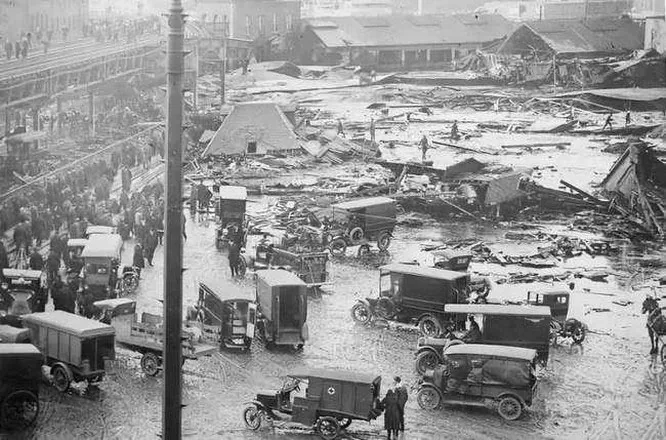
This is why a photograph taken afterward may not explain the moment of collapse. It shows a later condition, not necessarily the speed and force of the first wave.
The physics adds understanding without taking away the human experience. It helps explain why people could be overwhelmed by something that looked familiar and ordinary.
Rescue Became a Fight Against the Material Itself
Rescuers faced wreckage, unstable structures, and molasses that trapped people and animals. The sticky liquid complicated movement and access, while cold weather increased the challenge. Accounts of the response show that survival depended on quick help, but the conditions made reaching a victim far harder than an observer might imagine.
A street changed into a barrier in moments. People who knew the neighborhood now had to move through debris and a thick liquid that resisted their bodies.
Vehicles and buildings added hazards. A rescuer could not simply wade straight toward every person who needed help.
The rescue effort also involved work after the first dramatic scene. Searching damaged spaces, removing debris, and helping the injured took time.
The Victims Were More Than a Strange Headline
Boston in 1919 was home to families, workers, and children whose lives were not defined by a storage tank. The disaster entered those lives without asking whether they were ready.
The unusual material can overshadow that fact. A reader remembers syrup and forgets the people who could not get free.
A respectful account makes space for the loss. It avoids treating the flood as a funny break from ordinary history.
Its oddness is useful only if it draws attention toward the danger and the people affected. A memorable story should deepen our sense of their experience, not turn it into a novelty.
The Court Case Looked Past a Convenient Excuse
The owners blamed sabotage, but the long inquiry found negligence tied to the tank’s construction and management. That shift directed attention toward responsibility for a hazardous structure. Evidence about materials, workmanship, and warnings mattered more than a dramatic outside explanation that could have diverted scrutiny from the company’s own decisions.
Purity Distilling and its corporate ownership stood within a wider period of political fear. An accusation of sabotage could sound plausible in that setting.
But a plausible story still needed evidence. Investigators and the court had to assess the tank itself and the record of how it had been built and used.
The molasses tank collapse therefore became more than an unusual accident. It raised a question about who bears responsibility when a business places a dangerous structure among other people.
Responsibility Has a Physical Side
A company cannot answer a failed wall only with a story about intentions. Measurements, material, workmanship, and warnings belong in the discussion.
That is a practical lesson from the case. The condition of a structure can be examined even when people disagree about how to describe the event.
The inquiry also took patience. A large disaster can produce many claims and memories, and sorting them is not a quick task.
Its value lies in testing those claims against a physical and documentary record. An explanation becomes stronger when it survives that work, not merely when it sounds dramatic.
Why the Flood Still Matters Today
The disaster remains a lesson in structural failure, industrial oversight, and the risks imposed on nearby communities. Its unusual material makes it memorable, but the underlying questions are familiar: was a hazard understood, were warnings addressed, and who was responsible for keeping a system safe for the people around it?
The Great Molasses Flood belongs to a wider history of cities living close to industry. Work creates jobs and useful goods while also creating risks that may fall on others.
Those risks do not disappear because a product is familiar. A tank, pipe, or warehouse changes the scale at which that product can affect a neighborhood.
The flood also teaches us to ask about a system before trusting its appearance. A structure can look steady while hiding flaws that grow under repeated use.
Remember the Scale, Then the People
A modern account should explain why the liquid moved as it did. It should also remember that an explanation is not a replacement for the lives changed by the event.
The strongest image is not simply a wave of sweetness. It is an ordinary city street whose safety depended on decisions made elsewhere.
That connection reaches beyond Boston. People still rely on structures they did not design and cannot inspect on their own.
The story asks those who build and manage them to take that trust seriously. A familiar material can become a deadly force when a large system fails.
Frequently Asked Questions
The flood is remembered through its unusual name rather than its causes and consequences. These answers explain how a thick liquid could produce a dangerous surge, how much material escaped, and why the event belongs in industrial safety rather than a collection of harmless curiosities about the past.
How many people died in the Great Molasses Flood?
Twenty-one people died, and many others were injured. The disaster affected nearby residents and workers when the storage tank failed in Boston’s North End.
How much molasses was in the tank?
The tank held about 2.3 million gallons. Its large volume and stored height helped create the destructive surge after the walls gave way.
Was the disaster caused by a bomb?
The owners argued that sabotage was responsible. The legal inquiry instead found negligence tied to the tank and its management, rather than accepting that explanation.